After my Aussie travel adventures, especially after doing a workshop on brewing, I have been encouraged to take action towards a desired end. I've long fancied doing short courses, workshops or tutoring of home-made wine making. So I've started.
... So I'm going to "plug" myself for the first time. I won't do it again, instead I'll add a static page for those who are interested. But it's time I did something rather than waiting to get my words, prices etc perfect. This is that something.
If you're in the Essex area (U.K) then Chelmsford should be within reach. On the 20th and 27th of this month I'll be at The Ideas Hub 2, from 6.00 til 8.00 pm. I'll be hosting a very informal gathering for people want to start brewing or are keen to improve. It's a beginners and improvers thing. The cost is £10.00 pp for non members of the hub, and £8.00 for members.
The Idea's Hub 2 is in High Chelmer shopping Centre, opposite Greggs. If you live in Essex, especially Chelmsford, and you like my blog, then you'll like the Idea's Hub. And you can find out more about them here if you're on facebook. I'll try to find another link for those who are allergic to facebook.
So, these sessions will be very informal and chatty. Something like 2 hours of Q&A and discussion. I'll bring some wines to sample, tho be warned it is only a sample. What you're paying for is my time and the Hub's facilities. It's illegal to sell homebrew without a licence, I don't have a licence and I don't sell it. I also know that HMRC know all the tricks like bartering, raffling, selling novelty bottles with free contents. I just don't go there, it's not worth it, I like brewing too much to needlessly break the law. You're more than welcome to bring along your own creations of course!
I will absolutely be spilling the beans on everything I know that you ask me about. You know I don't hold back on my blog. If I know a tip, trip, simplification etc then I share it. I reckon I'll also be able to drop a little wonder on you, and raise a chuckle from time to time.
If you read my blog and haven't met me then I reckon I'd enjoy meeting you. Which takes me onto the next thing. I'm also happy to travel to your place and give a tutorial or workshop. I need to earn a living wage and cover my expenses so you my want to gather a group together to share the cost. I'm based in Essex (UK) so you can work out if it's reasonable for me to require overnight accommodation. If you read my blog and think "I must do that one day" but haven't then this may be what it takes. I'll buy in all the kit you need, and ingredients to get started. I'll charge you cost price + expenses for that, so no profit for me. You'll only pay for my workshop/tutorial on getting your first brew started. And if I have a friend nearby, and some good surf, then I'll probably be able to do a special deal to return a few days later.
As for my fee, well this is a new thing for me. Let's haggle, and barter too if you like. There's loads of things I need if you have skills but no cash. Leave a message below this post, with your email address. I won't publish it but will contact you.
It may not come over in my blog, but I empathise with those who want to brew naturally and achieve quality. So if this is you then I'm sure we can get you making great wine in your style. It may take a little more trial and error, but I'd love the experience ... you could barter with strength if this is you!
Monday, 17 June 2013

Elderflower Quickie (Apple & Grape Juices). Recipe etc
A few days after starting my first Elderflower wine of the year I'm sticking with my intentions of doing 20 gallons. Today I started the second of four 5 gallon batches, on the lees of the first batch. My aim is to make the same wine as the first batch, with one major difference. This one will be 50/50 apple juice and white grape juice. I hope that a comparison will reveal some useful stuff. But more on that in the discussion after the recipe etc.
Elderflower Quickie (Apple & Grape Juice)
Recipe (5 Gallons)
5 Litres White Grape Juice (Rio D'Oro)
5 Litres Apple Juice (Simply)
3.5 Kg Sugar
5 Teaspoons Pectolase
3 Teaspoons Tartaric Acid
3 Teaspoons Citric Acid
3 Teaspoons Yeast Nutrient (Tronozymol)
Water to 5 gallons
Yeast (Lees from last brew, GV 5)
Elderflowers
OG 1077
Method
When the previous brew (Elderflower Quickie) was moved from primary to secondary fermentation I was careful to leave the lees behind in the primary fermentation bin. This has a healthy colony of yeast in it which is perfect for brewing with. I had to leave the lees overnight before starting the brew. So I snapped the lid on the fermenting bin at the first opportunity. This delay is not necessary, infact it's a liability, but the sugar solution I had prepared to start the next batch with was not cooling down as fast as I anticipated. If I had added it then it may have killed the yeast in the lees. I just had to wait.
Next day, when the sugar solution was cool, I added all the ingredients to the lees in the fermenting bin. I added them sloshily, and then stirred and whisked the must for all the reasons mentioned in the last post. And then covered the bin.

From here on the method will be the same as the previous brew.
Discussion
One thing I'm very curious about in this brew is the role of malic acid (the main acid in apples) on the resulting wine flavour. It will probably be a subtle thing to discern. The flavour of apples may be the stronger effect by far. But malic acid is harsh tasting, so even tho it's a quickie wine (hence the ratio of apple juice to total volume is much reduced compared to a traditional brew) I hope I can perceive this. If I can't then I'll know I won't be turning in a wine ponce any time soon. But if I can then I'll have to be on the watch for ponceyness!
The yeast I normally use with apple juice is an acid reducing yeast. This means that it metabolises some malic acid, and produces lactic acid from it which not harsh. However, this time I didn't use such a yeast. So I reckon that I'll stand more chance of noticing the effect of malic acid. As much as I hope to learn something about this I definitely don't want to end up with wine that I don't like. I'm not that desperate to learn.
The other thing I'm curious about is the difference between a grape juice quickie compared to a 50/50 grape and apple juice quickie. I have no idea which I'm likely to enjoy more. Perhaps there will be no favourite, it'll depend on other factors, food, weather etc.
There will be, almost certainly, complicating factors that make a comparison a little uncontrolled. That no campden tablets were used for this brew is one. They don't only stun wild yeast, they also play a part in ester formation. Esters are intensely flavoured molecules, the stuff that flavours pear drops, pineapple chunks, and also gives some glues a distinct fruity smell. Some taste wonderful, some taste gross. I think this difference will be very small, probably imperceptible.
Another factor will be using the lees. I have never had any perceptible faults in my wines when i've fermented on the lees. However it may happen, especially because I had to leave it overnight. Unlikely but possible.
Oh yes, getting the OG the same for both batches, a fluke. I expected to be close when guesstimating the amount of sugar to use, but bang on well what can I say ... "the more I practice the luckier I get".
clicky here for a comparison of this year's elderflower wines, all 4 of them.
Elderflower Quickie (Apple & Grape Juice)
Recipe (5 Gallons)
5 Litres White Grape Juice (Rio D'Oro)
5 Litres Apple Juice (Simply)
3.5 Kg Sugar
5 Teaspoons Pectolase
3 Teaspoons Tartaric Acid
3 Teaspoons Citric Acid
3 Teaspoons Yeast Nutrient (Tronozymol)
Water to 5 gallons
Yeast (Lees from last brew, GV 5)
Elderflowers
OG 1077
Method
When the previous brew (Elderflower Quickie) was moved from primary to secondary fermentation I was careful to leave the lees behind in the primary fermentation bin. This has a healthy colony of yeast in it which is perfect for brewing with. I had to leave the lees overnight before starting the brew. So I snapped the lid on the fermenting bin at the first opportunity. This delay is not necessary, infact it's a liability, but the sugar solution I had prepared to start the next batch with was not cooling down as fast as I anticipated. If I had added it then it may have killed the yeast in the lees. I just had to wait.
Next day, when the sugar solution was cool, I added all the ingredients to the lees in the fermenting bin. I added them sloshily, and then stirred and whisked the must for all the reasons mentioned in the last post. And then covered the bin.

Another Gratuitous Picture. Ingredients.
Discussion
One thing I'm very curious about in this brew is the role of malic acid (the main acid in apples) on the resulting wine flavour. It will probably be a subtle thing to discern. The flavour of apples may be the stronger effect by far. But malic acid is harsh tasting, so even tho it's a quickie wine (hence the ratio of apple juice to total volume is much reduced compared to a traditional brew) I hope I can perceive this. If I can't then I'll know I won't be turning in a wine ponce any time soon. But if I can then I'll have to be on the watch for ponceyness!
The yeast I normally use with apple juice is an acid reducing yeast. This means that it metabolises some malic acid, and produces lactic acid from it which not harsh. However, this time I didn't use such a yeast. So I reckon that I'll stand more chance of noticing the effect of malic acid. As much as I hope to learn something about this I definitely don't want to end up with wine that I don't like. I'm not that desperate to learn.
The other thing I'm curious about is the difference between a grape juice quickie compared to a 50/50 grape and apple juice quickie. I have no idea which I'm likely to enjoy more. Perhaps there will be no favourite, it'll depend on other factors, food, weather etc.
There will be, almost certainly, complicating factors that make a comparison a little uncontrolled. That no campden tablets were used for this brew is one. They don't only stun wild yeast, they also play a part in ester formation. Esters are intensely flavoured molecules, the stuff that flavours pear drops, pineapple chunks, and also gives some glues a distinct fruity smell. Some taste wonderful, some taste gross. I think this difference will be very small, probably imperceptible.
Another factor will be using the lees. I have never had any perceptible faults in my wines when i've fermented on the lees. However it may happen, especially because I had to leave it overnight. Unlikely but possible.
Oh yes, getting the OG the same for both batches, a fluke. I expected to be close when guesstimating the amount of sugar to use, but bang on well what can I say ... "the more I practice the luckier I get".
clicky here for a comparison of this year's elderflower wines, all 4 of them.
Sunday, 16 June 2013
Elderflower Quickie 2013. Recipe etc.
After returning from our travels it took me time to start brewing. Yet again I missed the small window of opportunity for having my first crack at Silver Birch wine. A wine I have wanted to make since first reading a homebrew book. And yet again I didn't make dandelion wine. Worse still I didn't even make a quickie wine. So, when Elderflower season approached, and the year was into middle age, there was only one thing to do. Commit to my biggest Elderflower wine brewing ever. The plan is 20 gallons, in four different 5 gallon batches, this is the first batch. It should set me on course for making 50 gallons this year.
Elderflower Quickie. Grape juice only.
Recipe (5 gallons)
10 Litres White Grape Juice (Rio D'Oro)
3 Kg Sugar
5 Teaspoons Pectolase
3 Teaspoons Tartaric Acid
3 Teaspoons Citric Acid
3 Teaspoons Yeast Nutrient (Tronozymol)
3 Camden Tablets (crushed)
Water to 5 gallons.
Yeast, Gervin 5 (GV5).
2 carrier bags, loosely packed elderflower sprays.
OG 1077
Method
As per usual really. Got all my kit sterilised and rinsed, especially important after a long break. After that i dissolved the sugar in water as it boiled. Added that to the fermenting bin, put the lid on, and let the heat and steam ensure the sterilisation was full and complete. Then added all the other ingredients starting with grape juice, then water, then the dry stuff excepting the yeast and flowers.

I gave the whole lot a long stir to ensure it was well mixed. This is important because there is a chance that the super dense and sweet sugary solution will sit at the bottom of the fermenting bin if it's not done. You can't get an accurate OG reading when that happens. (Also, if yeast was added to a layered brew then it probably wouldn't be able to do anything with that sweet dense layer). Then I measured the gravity, and then put the lid on. I waited with adding the yeast because of adding crushed campden tablets. Just ensures that any wild yeasts will not get going on my delicious nutritious broth.
Next day the must got a long session with an egg whisk, this is to put plenty of dissolved oxygen into the must. (It will also drive off some of the sulphites from the Campden tablets). Yeast needs oxygen this to bud (reproduce) and so form a healthy sized colony for a timely brew. Then I pitched the yeast and covered.
For 4 days, once a day, I stirred the must with a whisk for the same reason given above. On day 5 the sun came out so off I went to collect Elderflowers. It's still a little early for them so I had to cycle about 10 miles to gather enough. I then put them in a large plastic bag, tied it up, and left them overnight. Next day shook the bag for about 10 minutes (in advert breaks during a good movie!). Most of the flowers dropped off the sprays, the loose flowers were put into a muslin bag. The rest (about 1/4 - 1/3 of the total) were put back into the plastic bag for another night.
The must (Gravity 1030) was transferred to secondary fermentation - under airlock - by a combination of siphoning initially, and then decanting when the fermenting bin was light enough to handle with ease. The decanting was done with extra care because I want to keep the lees for starting the next brew.
The flowers in the muslin bag were then added to the secondary container, and the airlock fitted. Next day the flowers in the plastic bag were shaken off their sprays, put into a muslin bag, and added to the must in the secondary fermentation container.
From here on it will be the usual routine, racking to demi-johns in a few days, stabilising if required, degassing if preferred, racking after clearing.
Discussion
The bagging and shaking of elderflowers will save you a massive amount of time and tedium with a fork. It's the best wine tip I've learned in the last couple of years, but we do like Elderflower wine!
Adding the flowers at the secondary fermentation stage means you need less flowers, for 2 reasons. First the fermentation has quietened down, when it's vigorous then lots of the delicate volatile flavours from the elderflowers get blown out of solution. At secondary stage this happens significantly less, so you get more of those yummy favours in your wine. Also, at secondary stage you have an alcoholic brew. It's about 5% or so, but nevertheless the alcohol adds to the flavour extraction. It will dissolve some things better than water alone. Oily type molecules especially, which also taste good.
There's nothing special about the unusual brand of sugar used. Usually I buy Silver spoon because it's made more or less locally. It seems madness to me to buy sugar that has come thousands of miles when, for the same price, you can get something local. One day the cost of fuel for moving such commodities so far will make it economic insanity, so supporting something local will help to ensure it's still available when those times come. Uh oh ... I got a bit "politically eco" then didn't I! This packaging didn't say anything about country of origin, neither did it say if the source was cane or beet. So there's a good chance that I shot myself in my eco foot. But it was the only sugar in the store.
clicky here for a comparison of this year's elderflower wines, all 4 of them.
Elderflower Quickie. Grape juice only.
Recipe (5 gallons)
10 Litres White Grape Juice (Rio D'Oro)
3 Kg Sugar
5 Teaspoons Pectolase
3 Teaspoons Tartaric Acid
3 Teaspoons Citric Acid
3 Teaspoons Yeast Nutrient (Tronozymol)
3 Camden Tablets (crushed)
Water to 5 gallons.
Yeast, Gervin 5 (GV5).
2 carrier bags, loosely packed elderflower sprays.
OG 1077
Method
As per usual really. Got all my kit sterilised and rinsed, especially important after a long break. After that i dissolved the sugar in water as it boiled. Added that to the fermenting bin, put the lid on, and let the heat and steam ensure the sterilisation was full and complete. Then added all the other ingredients starting with grape juice, then water, then the dry stuff excepting the yeast and flowers.

Ha! Gratuitous piccie time!
I gave the whole lot a long stir to ensure it was well mixed. This is important because there is a chance that the super dense and sweet sugary solution will sit at the bottom of the fermenting bin if it's not done. You can't get an accurate OG reading when that happens. (Also, if yeast was added to a layered brew then it probably wouldn't be able to do anything with that sweet dense layer). Then I measured the gravity, and then put the lid on. I waited with adding the yeast because of adding crushed campden tablets. Just ensures that any wild yeasts will not get going on my delicious nutritious broth.
Next day the must got a long session with an egg whisk, this is to put plenty of dissolved oxygen into the must. (It will also drive off some of the sulphites from the Campden tablets). Yeast needs oxygen this to bud (reproduce) and so form a healthy sized colony for a timely brew. Then I pitched the yeast and covered.
For 4 days, once a day, I stirred the must with a whisk for the same reason given above. On day 5 the sun came out so off I went to collect Elderflowers. It's still a little early for them so I had to cycle about 10 miles to gather enough. I then put them in a large plastic bag, tied it up, and left them overnight. Next day shook the bag for about 10 minutes (in advert breaks during a good movie!). Most of the flowers dropped off the sprays, the loose flowers were put into a muslin bag. The rest (about 1/4 - 1/3 of the total) were put back into the plastic bag for another night.
The must (Gravity 1030) was transferred to secondary fermentation - under airlock - by a combination of siphoning initially, and then decanting when the fermenting bin was light enough to handle with ease. The decanting was done with extra care because I want to keep the lees for starting the next brew.
The flowers in the muslin bag were then added to the secondary container, and the airlock fitted. Next day the flowers in the plastic bag were shaken off their sprays, put into a muslin bag, and added to the must in the secondary fermentation container.
From here on it will be the usual routine, racking to demi-johns in a few days, stabilising if required, degassing if preferred, racking after clearing.
Discussion
The bagging and shaking of elderflowers will save you a massive amount of time and tedium with a fork. It's the best wine tip I've learned in the last couple of years, but we do like Elderflower wine!
Adding the flowers at the secondary fermentation stage means you need less flowers, for 2 reasons. First the fermentation has quietened down, when it's vigorous then lots of the delicate volatile flavours from the elderflowers get blown out of solution. At secondary stage this happens significantly less, so you get more of those yummy favours in your wine. Also, at secondary stage you have an alcoholic brew. It's about 5% or so, but nevertheless the alcohol adds to the flavour extraction. It will dissolve some things better than water alone. Oily type molecules especially, which also taste good.
There's nothing special about the unusual brand of sugar used. Usually I buy Silver spoon because it's made more or less locally. It seems madness to me to buy sugar that has come thousands of miles when, for the same price, you can get something local. One day the cost of fuel for moving such commodities so far will make it economic insanity, so supporting something local will help to ensure it's still available when those times come. Uh oh ... I got a bit "politically eco" then didn't I! This packaging didn't say anything about country of origin, neither did it say if the source was cane or beet. So there's a good chance that I shot myself in my eco foot. But it was the only sugar in the store.
clicky here for a comparison of this year's elderflower wines, all 4 of them.
Brewing Wine Down-Under
So, I got very lucky for the winter of 2012/13 and ended up travelling to Australia. If you're returning to my blog then you'll know this already.
Me and Mrs Critter Wines had 3 months there. Flew into Sydney and spent a few days there, then headed south to Bowral for a few days, then headed to Northern New South Wales (Byron Bay area) for a few weeks. That was all visiting family of Mrs Critter Wines (Mrs CW). From there we flew west to Perth and made the area our base for 2 months (of course we spent time in Margaret River too). Just enough time to do a quickie wine. What made it extra special was that Mrs CW has a house in an intentional community in Fremantle. So I did a class on winemaking.
A few enthusiastic members of the community gathered for an informal workshop. As they welcomed us so warmly, and it was around Xmas, it was only fitting to buy in the gear and put on the workshop as a gift. It was great to find that home brewing is popular there, so finding a homebrew shop was a breeze.

We made 2 wines. One a straight up quickie wine from apple juice and grape juice. The other was a quickie wine base but with mulberries added during secondary fermentation. The mulberries came from the tree on the intentional community, which made it special. I was overly concerned that trying something new could produce disappointing results, so I pushed for doing the straight quickie wine first. The delight was that the experienced brewer got it wrong ... the straight forward quickie wine was a little disappointing. Tho it was bottled and sampled at the earliest opportunity and waiting two weeks longer would have probably made all the difference.

The smell of the mulberry wine, which was conditioning at the time, was simply delicious! How fitting that something so much a part of the community should be the better brew. How brilliant too - for the confidence of the potential future brewers - that they should trump the "teacher".
Sadly, I cannot remember the recipes and methods, and I've misplaced my notes, but nothing was very different to my usual stuff. Yeast, I do remember, for both brews it was Vintner's Harvest MA33. The mulberry wine was made on the lees of the first brew. The mulberries had been frozen and when added to the base brew at secondary fermentation stage after defrosting.
The two brews were each 3 gallons, and I'm definitely adding them to my total for 2012 brews. It still leaves me short of my target 50 gallons for that year, but I reckon all that time away is a good enough excuse.
All that remains to be said is a huge thanks to all who make Pinakarri the wonderful place that it is.
Me and Mrs Critter Wines had 3 months there. Flew into Sydney and spent a few days there, then headed south to Bowral for a few days, then headed to Northern New South Wales (Byron Bay area) for a few weeks. That was all visiting family of Mrs Critter Wines (Mrs CW). From there we flew west to Perth and made the area our base for 2 months (of course we spent time in Margaret River too). Just enough time to do a quickie wine. What made it extra special was that Mrs CW has a house in an intentional community in Fremantle. So I did a class on winemaking.
A few enthusiastic members of the community gathered for an informal workshop. As they welcomed us so warmly, and it was around Xmas, it was only fitting to buy in the gear and put on the workshop as a gift. It was great to find that home brewing is popular there, so finding a homebrew shop was a breeze.

We made 2 wines. One a straight up quickie wine from apple juice and grape juice. The other was a quickie wine base but with mulberries added during secondary fermentation. The mulberries came from the tree on the intentional community, which made it special. I was overly concerned that trying something new could produce disappointing results, so I pushed for doing the straight quickie wine first. The delight was that the experienced brewer got it wrong ... the straight forward quickie wine was a little disappointing. Tho it was bottled and sampled at the earliest opportunity and waiting two weeks longer would have probably made all the difference.
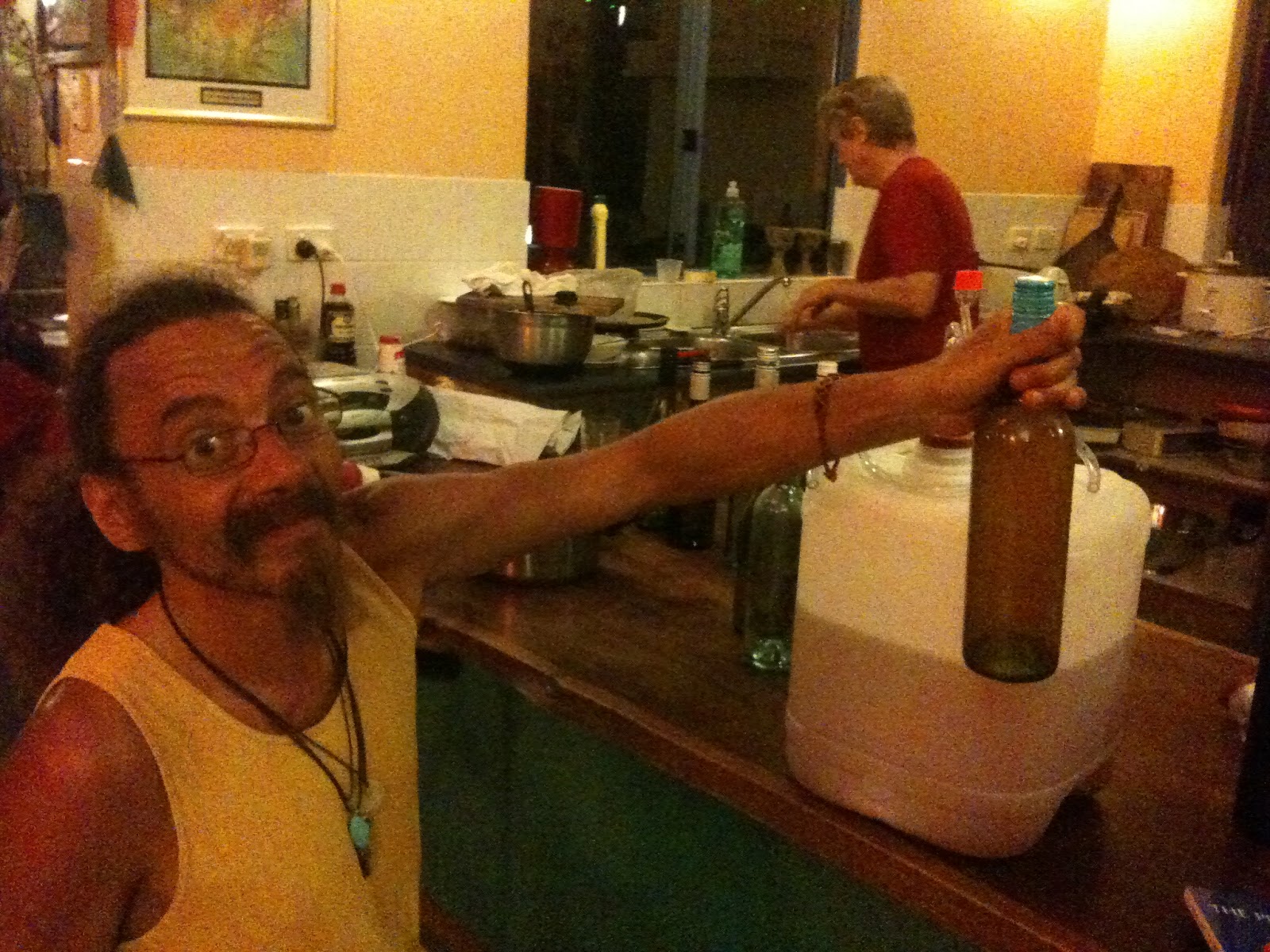
The smell of the mulberry wine, which was conditioning at the time, was simply delicious! How fitting that something so much a part of the community should be the better brew. How brilliant too - for the confidence of the potential future brewers - that they should trump the "teacher".
Sadly, I cannot remember the recipes and methods, and I've misplaced my notes, but nothing was very different to my usual stuff. Yeast, I do remember, for both brews it was Vintner's Harvest MA33. The mulberry wine was made on the lees of the first brew. The mulberries had been frozen and when added to the base brew at secondary fermentation stage after defrosting.
The two brews were each 3 gallons, and I'm definitely adding them to my total for 2012 brews. It still leaves me short of my target 50 gallons for that year, but I reckon all that time away is a good enough excuse.
All that remains to be said is a huge thanks to all who make Pinakarri the wonderful place that it is.
Well, where has the time gone?
Grief, I very much hope that you're all still out there. I've been neglecting my blog. The lengthy travels was one thing but getting back into a routine has been quite another. Infact the old routine has gone and I've been carving out a new one. I won't say anything about that because I want this blog to remain focused on brewing wine only ... and brewing wine is definitely still a significant part of my life.
I'm going to do some posts right away. One regarding home brewing adventures in Australia, and the others about this year's brews. I've been bad and only got active in the last week, but I'm keen to make up for lost time cos that 50 gallon a year target is important to me if I want to carry on being generous with my concoctions.
 Talking brewing ... this is Little Creatures in Fremantle (Western Australia). It's a well established "pub" that brews it's own beers, yup beer as in ale not lager. So all those shiny vats are full of beer. Just before we arrived the business sold for - I believe - (Aus) $350 million.
 Little Creatures wasn't the only Fremantle pub selling beers made on the premises, or locally. It seems that Australians are getting into the malty hoppy stuff.
Of course, since getting home I've been busy bottling and drinking wine ... well you have to empty those demi-johns otherwise there's no room for new stuff!
I'm going to do some posts right away. One regarding home brewing adventures in Australia, and the others about this year's brews. I've been bad and only got active in the last week, but I'm keen to make up for lost time cos that 50 gallon a year target is important to me if I want to carry on being generous with my concoctions.
 Talking brewing ... this is Little Creatures in Fremantle (Western Australia). It's a well established "pub" that brews it's own beers, yup beer as in ale not lager. So all those shiny vats are full of beer. Just before we arrived the business sold for - I believe - (Aus) $350 million.

Of course, since getting home I've been busy bottling and drinking wine ... well you have to empty those demi-johns otherwise there's no room for new stuff!
Wednesday, 31 October 2012
Blueberry & Cranberry Quickie Recipe
Wow, the year is rattling by and my total volume of wine brewed looks unlikely to reach 50 gallons. I'm off to Oz for 3 months, first time on a plane in - I think - 8 years! So unless someone in Oz wants me to drop by and brew with them, or get them started on homebrewing, then I'll be unlikely to reach that target.
With that in mind I decided to get busy and squeeze a quickie wine in before heading off. It's a repeat of one I've brewed before, indeed one I already brewed this year. But it's delicious, can't have too much of it really, and it'll be perfect for when we get back, 5 gallons of it.
Recipe for 5 Gallons
5 Litres Red Grape Juice (Vitafit)
3 Litres Cranberry Juice (Sun Grown)
2 Litres Blueberry Juice (Supermarket own brand)
3.4 Kg Sugar
3 Teaspoons Citric Acid
2 Teaspoons Tartaric Acid
4 Teaspoons Pectolase
Yeast Nutrient (Tronozymol)
Yeast Gervin Number 5 (GV5 1 year beyond BBE date!)
Original Gravity (O.G.) = 1078

Gratuitous piccy of the main ingredients
Method
Dead easy one, it's like any quickie wine.
Dissolve the sugar in about 1.5 - 2 gallons of boiled water (or very hot anyway).
Tip it into your fermenting bin, add fruit juices, water to 5 gallons, acids, enzyme, nutrient. Check the temperature, if it's around room temp or a little higher then it'll be fine, any hotter and leave it to cool down (covered). Stir very sloshily to get lots of air dissolved (I use an egg whisk for anything up to 5 minutes, but a minute also seems to work fine). Then chuck your yeast in.
Now cover it. Next day it should be on the go. Then each day, for the next few days, stir it sloshily for a minute or so, then recover. After a few days to a week transfer it to secondary fermentation, this means under an airlock. No need to be particularly careful about the sediment.
After a few more days, possible another week, it'll probably have finished fermenting. You'll get the same reading on your hydrometer for a few consecutive days when it's finished. At this point rack it to demi-johns, being careful to leave the sediment behind. Don't worry if a bit get's carried over tho.
Now you stick the airlock on and leave it be. It'll almost certainly clear unaided, and be ready to drink 6-8 weeks from when you started it. It'll improve a little for the next couple of months, and that'll be it then. Not worth laying down cos it wont improve anymore. This is a table wine, the likes of which you'd pay a few £'s for in the supermarket. So it's quality is quite something when you consider it takes weeks to make and costs you about 30p/bottle.
Discussion
Silverspoon sugar (for you guys in the UK) is made with sugar beet. If you care about food-miles then this is a cracking choice. If you buy cane sugar, but not fair trade, and have a troubled conscience then buy this instead. (If you buy fair trade then big thumbs up to you). Some say that beet sugar tastes different and not as good, well for us mere mortals it all tastes like what it is, refined sugar, the same stuff. The only people who drink wine but don't like mine are those who are too poncey to even try it, or too proud to admit it.
Things to watch out for when you buy tetra pack juice for making wine.
Always avoid juices with E223 (sodium metabisulphite) and/or E202 (Potassium Sorbate). They'll interfere with your yeast and your brew may not even get started. E202 stops yeasts from multiplying (budding), and E223 stuns yeasts.
Try to get pure juice, from concentrate is fine. But anything else added could take you on a mystery journey that I don't make. Things like vitamin C (ascorbic acid), lemon juice (citric acid) etc will probably be fine but artificial sweeteners, preservatives, flavourings, colours etc. I dunno what they'll do to your wine. I've never tried them. You don't need to anyway, the juices I use are not special, not hard to find, not expensive either.
This is a great wine type, the quickie. Do experiment with it, but leave some things the same.
- Always use 1 litre of grape juice per gallon of wine. (Red or white/green is fine).
- Always use 1 litre of any other juice (or combo) per gallon of wine.
- Always keep your Original gravity less than 1080. 1070 isn't even too low.
You'll probably still need 1 teaspoon of acid per gallon wine. Take your pick, or mix them up.
You'll probably want to use nutrient cos yeast needs nutrients just like we do, and these brews are usually nutrient poor because the high water:juice ratio.
You'll get better results if you use a specialist yeast, any homebrew shop has a selection. If you don't know what you're doing then ask for advice, or ask to read the labels. They'll give a clue (e.g. for red/white wines, sparkling wine, acid reducing - great if you use apple juice - , preferred temperature range of the yeast etc). You'll be able to work it out. Pick what suits you, find out what temperature your brewing room is at. Choose a yeast that suits the temperature, it makes a BIG difference. Hotter is not better.
- Many folk instantly think of grape/pineapple for a combo. Go for it! I wasn't much impressed but that's just my taste. A friend made some and loved it, more than any other.
- Grape/Apple works well for a crisp clean white wine.
- Grape/Pomegranate is delicious
Once you started doing these wines you'll probably be hooked on them. They are cheap and easy and really very drinkable indeed. Which means you get to stock up and the other wines you make, on the pulp etc, get the time they need to condition. i.e. you're not tempted into drinking them too young. You'll soon find yourself experimenting ... hmm I wonder what happens if I use this as the base for elderflower wine? I did, and that's the only elderflower wine I make these days. Mind you I make about 10 gallons a year.
'Nuff of my ramblings, happy brewing.
'Nuff of my ramblings, happy brewing.
P.S. If you live in Oz and want to link up, especially if you want to learn how to brew wine (or improve), then get in touch, leave a comment. I'll be Perth general area from mid december til february. November flying through Sydney, Bowral and a place whose name I cannot remember that is not a million miles from Byron Bay. If you live near a good surf beach, and have a spare bed for me and my better half, then I reckon we're close to making a perfect swap!
Hey, it's strange times we're living in so I'm sending out dreamy requests to see what happens. ;-)
Hey, it's strange times we're living in so I'm sending out dreamy requests to see what happens. ;-)
Subscribe to:
Posts (Atom)