I like to brew wine; It's only a hobby but I'm obsessed!
This is the place to be if you want to see what another brewer is up to or want some encouragement to start or diversify. I've posted heaps of recipes (clicky) and 2 wine-making vids (here for wine made from cartons of juice blog / youtube, and here for Blackberry wine on the pulp blog / youtube).
If you're new here then do explore, take this link for tips about where to find what you're interested in.


Wednesday, 17 February 2016

4 Elderflower Quickies. Made in June & July 2015

Looking back I can't believe it was June before i did my first brew of 2015. Being that it was then elderflower season there was no way i would miss out on this, so it was the kick in the pants i needed to brew!

Regular readers will be familiar with my elderflower wine production wine. So I'm going to post all 4 wines here. New readers may want to look back at previous blog entries for elderflower quickie wine to get a fuller description.

This year's significant experiment was playing with the added acids. Mrs Critter Wine prefers her wines to be easy on acidity. So i guessed the main problem for her may have been tartaric acid. So i made some without that and used only citric acid, which has a fruity flavour.

Personally speaking i get on fine with the clean crisp acidity of tartaric acid. So i continued to use a blend of that and citric acid for some of the wine. The result was not a marked difference. However Mrs CW hasn't commented on the acidity being too much for her, so perhaps it worked? Then again she didn't comment for any of the variations, so perhaps she's adjusted?

What i noticed is that the citric acid only version is a little softer. But only a little, and so i can't rule out deceiving myself. Having said that i perceive an edge to the acid blend version that i prefer. Anyway, enough rambling, here's the recipes i used in 2015.

Recipes:

1st Batch: 5 Gallons
NB i left the flowers and must in the secondary fermentation vessel for 2 weeks. Not what i'd recommend, but more on this later.

10 Litres Reg Grape Juice (Don Simon, pure pressed)
3 Kg Sugar
5 Teaspoons Pectolase
4 Teaspoons Citric Acid
2 Teaspoons Tartaric Acid
4 Teaspoons Yeast Nutrient (Tronozymol)
Yeast (GV1)
Water to 5 gallons
3 Litres Elderflowers

OG: 1076

2nd Batch: 5 Gallons
NB this must for this wine was left in the primary fermenter for 2 weeks. It had therefore more or less finished fermenting when i moved it to secondary and added the flowers. Not what I'd recommend but more on that later.

Almost exactly the same ingredients and quantities as above. The only differences being that i added no pectolase and used the lees left from the previous brew instead of adding fresh yeast. OG, not surprisingly, was also the same.

3rd Batch: 5 Gallons

Very similar ingredients to above wines but with a variation in acids. Here's the list, for clarity.

10 Litres Reg Grape Juice (Don Simon, pure pressed)
3 Kg Sugar
5 Teaspoons Citric Acid
4 Teaspoons Yeast Nutrient (Tronozymol)
Yeast (GV1, lees from previous brew)
Water to 5 gallons
3 Litres Elderflowers

OG unknown cos my hydrometer broke, but it's safe to assume the same as above, i.e. around 1076.

4th Batch: 5 Gallons

Back to an acid blend, but different to batches 1 and 2. Also a difference in juices. The ingredients list then, again for clarity.

4 Litres Reg Grape Juice (Don Simon, pure pressed)
6 Litres Reg Grape Juice (Asda, Pure Pressed)
3 Kg Sugar
3.5 Teaspoons Citric Acid
1.5 Teaspoons Tartaric Acid
4 Teaspoons Yeast Nutrient (Tronozymol)
Yeast (GV1, lees from previous brew)
Water to 5 gallons
3 Litres Elderflowers

OG unknown cos i hadn't replaced my broken hydrometer. If my memory serves me Asda RGJ is a little sweeter than Don Simon. So OG may be a few points up, i'd guess no higher than 1080 tho.

Method

For all wines this is a summary of the method.

1st Batch:

Flowers were collected on a dry and sunny day. They were put into bin bags, on their sprays. The bags tied up and left overnight. Next day the bags were shaken for a few minutes so they fell off their sprays. The flowers (and the pollen) were measured in 3 litre batches and put in freezer bags. Measure the flowers without pressing them into the measuring jug. And only shake them down enough to get a flat level for easy reading against your measure. Put them in the freezer.

Dissolve the sugar in hot water. Dissolve the acids and nutrient in water. Add all ingredients (except the flowers and yeast) to a fermenting bucket and stir well. Ensure the temperature is not too high to knobble the yeast. Measure the gravity.

Add the yeast. Cover. Once a day, for the next few days, stir the must sloshily and recover. After 5-7 days transfer to secondary fermentation vessel under airlock. Make sure to leave plenty of sediment in the primary fermentation vessel cos you'll want it for the next batch. Add 3 litres of flowers in a tied up muslin bag, or two.

After another 5-7 days remove the bagged flowers and rack the wine to demi-johns and fit airlocks. Leave for at least 4-5 weeks. By which time it'll be clear. Amazingly it'll also be ready to drink. It'll improve for the next 4 weeks or so. You can bottle it now if you want.

2nd, 3rd and 4th Batches:

Dissolve the sugar in hot water then allow it to cool. Dissolve the acids and nutrient in water. Add all ingredients (except the flowers and yeast) to a fermenting bucket containing the lees from the previous brew, stir well. There's no need to add yeast. Measure the gravity.

From here proceed as above for batch 1, tho you won't need to stir daily during primary fermentation.

Miscellaneous Bits and Pieces

As i mentioned earlier i didn't rigidly stick to my preferred timing. I got ill and couldn't tend to the brewing. The good news is that it doesn't seem to have made a difference. I won't be repeating the 2 week primary fermentation, neither the 2 week long flower infusion at secondary fermentation. But it's good to know it need not spoil the wine if you get a little slack.

Looking Back on 2014

So I didn't hit my target volume of wine in 2014, I came quite close tho.

A highlight was making a big batch of a quickie wine that i dabbled with the previous year, passion fruit. It was a very nice quickie, as good as any straight-up quickie i've made previously. By straight-up i mean nothing added to the quickie base as in elderflower or green tea & ginger wines.

It was a good year for making various blackberry wines too. One of which was particularly good.

The orange wine formulation and method is coming along nicely. It's no longer so sweet but remains a sweet wine and maintains it's strength. In my early days i used way too much sugar, which didn't completely ferment. These days i'm still using enough "excess" sugar to deliver a sweet wine but it's not overkill. I think my most recent recipe or 2 have nailed it now.

Each year's orange wine will be a little different tho. This is because the ratio of various citrus fruits changes depending on what's available to me, and the fruits must also fit my pretty limited budget. However it always works out with a great balance of similar and complimentary flavours.

Of course Elderflower wine was the usual biggest brew. It remains a firm favourite with friends and people who have a distrust of homebrew quality. It also remains a favourite of ours personally, and making a lot means it's our everyday wine.

And talking of favourites another batch of green tea & ginger was made and again delivered in trumps. If possible the next time i make this i'll use the same green tea.

2015 was another quiet brewing year. But that's for a number of posts i'll be writing soon.

Monday, 5 January 2015

Orange Wine: Recipe

Making orange wine is a labour of love, but it's worth it. This is a delicious drink worth saving for winter. It's sweet, strong, zesty and has a texture like a liquer.  Last time i made it was a couple f years ago. Last time i drank it was about a week ago. That was a glass from one of the few remaining bottles and so, with added pressure from Mrs Chateau Hippo, it was time to make more so we'd have some next winter. And any other time we want a dessert wine cos this is the only one i make. It's that good. One size fits all.

And for you oldskool types out there, who love CJJJ Berry (and who doesn't when it comes to brewing wine) you'll find this recipe very familiar, but tweaked. We all tweak as brewers, cos we all think that either we know better or we know ourselves well enough to adapt a recipe for our tastes or preferences. So i tweaked CJJJJJJJ Berry. Back in his day of course there probably wasn't such a thing as organic fruit, it was likely just called fruit. I'm using organic cos i like it in every way, but in this recipe it's actually important to use organic regardless of your beliefs. You will be using the skins of many fruits and pesticides etc are on those skins, so take no chances. you're not meant to consume pesticides. If you don't believe me then look some up, do some research, and pay attention to COSHH (chemicals and other substances hazardous to health). Washing isn't the whole solution here, the zest will be infusing for days. Get organic, and it'll taste better anyway. Which is a big deal with homebrew right!

I started this on December 31st, alas missing my target for total brews in 1014, 50 gallons, and making a mere low 40's instead. Must do better this year! But the quality of what i made last year is a great consolation prize, and i didn't drink for half of december, which probably adds up to 2 gallons worth ;)

Recipe - 3 gallons

Juice of 30 Organic Juicing Oranges
Juice of 18 Organic Italian Clementines
Juice of 6 Organic Lemons
Juice of 2 Organic Pink Grapefruit
Juice of 1 lime
Zest from Organic 24 oranges and 4 Organic lemons
4.5 kg Sugar
2 Tspoon Citric Acid
2 Tspoon Tartaric Acid
4 Tspoon Pectolase (Pectic enzyme)
6 Tspoon Yeast Nutrient (tronozymol)
Water to 3.5 gallons
Yeast (Gervin 3, GV3)

Original Gravity 1124

Method

This is a labour of love so use your time well. Start with a clean and tidy working area, you'll need the space. put the sugar in a large pan and add about a gallon of water. Bring it to the boil and so  dissolve the sugar, stir occasionally to make sure there isn't a lump of sugar burning on the base. While you're letting that happen wash the oranges and lemons you'll be zesting.

Now zest the oranges and lemons, fastidiously. You don't want any pith in your wine, it'll make it bitter. Which is not the same as sour, it doesn't work. Be a real stickler for this. I use a potato peeler to get the zest off and then still take a sharp knife to the skin to remove all traces of pith. If you know the expression "the most dangerous thing in a kitchen is a blunt knife" then you'll know the value of a regularly sharpened knife. Sharpen it and you'll save vast amounts of time and won't chop your fingers off or pulp the zest. If you have a scary grater that you've injured yourself with previously then its probably a good thing to use. But resist the temptation to get as much zest as possible, instead aim for getting the very best quality zest only.

By the time you've done this the sugar solution will probably be boiling. Tip it into your fermenting bin and put the lid on. The steam will do a great job of sterilising it, tho you should have made sure it was clean and chemical free already. Chop up the zest into pieces about half the dimensions of a match stick. Put the zest into a muslin bag and tie it up. Add to the fermenting bin and put the lid on.

Now juice all the rest of the fruit. Hold on, don't use a juicing machine. This must be old skool stylee. A juicing machine will add loads of tiny wee fragments of pith, pips and juice that has been in contact with macerated pith and pips. This'll make your wine bitter and you won't like it. So you gotta get that old skool orange juicing gizmo or squeezer out and give yourself some hand cramps. No other option. And if you're not in practice then you may need to up the fruit content by 10-30%. I have strong hands and use them a lot for repetitious stuff (which all sounds quite deviant but actually i walk with crutches ... so it's very boring!). In short i get more juice from my fruit than most would. Is that showing off ;-)

Add the juice to the fermenting bin and put the lid on. Then dissolve all the other stuff (except the yeast) in water, 0.5 - 1 litre should do it, and add to the fermenting bin. You've probably got somewhere close to 2 gallons in there, so make the volume up to 3 gallons and measure the gravity with your hydrometer. Hopefully it's way high, even beyond your hydrometer scale. Mine was something like 1135, off the scale so couldn't tell, had to guesstimate. I added enough water to make the volume up to 3.5 gallons. Including the muslin bag of zest. The gravity then was 1124. Last brew was 1122 and that wine was delicious. So i stopped there. it's close enough.

Then i added my yeast. This is probably the most important wine to make a good choice of yeast for. Something sweet and strong really needs a yeast that you can depend upon to do what it says "on the tin". I used to use Vintner's Harvest Sauternes yeast, and it worked great.. Then i couldn't get it and was told that Gervin number 3 (GV3) was great for sweet wines with high alcohol by volume and start's fine in a super sweet must. So i use that, sprinkle it onto the surface, put the lid on, tightly.

As for all your other brews after a few days to a week or so move the wine to secondary fermentation, and when you do remove the muslin bag of zest. I think you can err on the side of length for this brew. Maybe primary ferment for upto 10 days. Keep an eye on it tho. It may be slow to start due to the high sugar content. So it may need extra sloshy stirring (i use an old skool egg/cream whisk) to help the yeast bud (breed). Or may need more time to get busy. This is a sweet strong wine, everything about it takes longer.

When it's stopped fermenting, which may be weeks or months, then rack it to fresh demi-johns. That is siphon so you leave the sediment behind. And if it's still fermenting after 2 months and has deposited a substantial sediment (0.5 - 1.0 cm) then rack it anyway and let it ferment more with a much reduced sediment. It may take a long time but the sediment can taint the wine. ultimately the best bet is to keep an eye on the gravity too. If it's not going down quickly then leave it on the sediment cos it'll need all the yeast it can get. But if it is going down rapidly then you can afford to remove most of the sediment. There's a bit of an art to this, and you'll probably get close enough to a brilliant result however you do it. From there on you'll be refining this wine.

The wine, if i remember right, always clears without needing finings. Don't expect to drink it until it's at least 6 months old. A year is a respectful wait and worth it. And if you have enough capacity to set a bottle or two aside and forget about them then some years later you'll be in heaven when you open one.

 If - at the bottling stage - you're at all unsure about whether to use stabilisers like campden tablets and potassium sorbate (both) then use them. This is sweet wine with  a high tolerance yeast. There will be enough residual sugar for more fermentation and as conditions change your tiny invisible yeasts may burst back into life, start to bud, and ferment. If this happens in a bottle you'll either blow the cork, or if using a screw cap your bottle will go off like a glass grenade. In a normal wine the low final gravity at bottling is often safety enough. but with a high final gravity then caution is wisdom.

Discussion

I'd advise anyone making this wine to go wild and do your own thing with the fruit combo. Keep the lemons in there at around 2 per gallon. Then for all the rest of the fruit juggle it about. If you;re not feeling too bold then keep the oranges and mix up the clementines, tangerines, satsumas, mineolas etc etc according to what you like and/or what is cheap and/or available. You will end up with a citrus wine like mine but different. It's differentness is it;s delight. so the subtle difference resulting from your own mix of "little oranges" will only really matter to you. and that is because you are paying most attention, not because you're a super-hero ;-) I like adding grapefruit cos i'm quite partial to it, i eat them like oranges occasionally and never add sugar to them. This wine has residual sugar, it's sweet. so if you like sour anyway then try some grapefruit. Similarly if you like what lime has to offer throw that in too, replace 1:1 for lemons.

Wednesday, 31 December 2014

Green Tea & Ginger Wine; Recipe

So this is an old favourite wine as my regular readers will know. I wish i could copy last years wine cos it was great,and i wish i could copy a recipe from 3 years ago cos after those years of laying down the wine was exquisite. Alas, it was not possible. But with experience you get good enough with you art to adapt. So this is an adaption, and so plays it's part in the evolution of the wine. I'm confident enough in my abilities to brew 5 gallons of it anyway. And if you like a curry, and also like a crisp interesting wine then give this a go. It's a match made in heaven.

Recipe: 5 Gallons

10 Litres Red Grape Juice (Asda, pure oressed)
3.1 Kg Sugar
200g Fresh Root Ginger
200g Luponde Green Tea (East Afrikan, fairtrade, suki-tea.com)
Zest of 3 Lemons (organic)
Zest of 2 Limes (organic)
5 TSpoon Citric Acid
5 TSpoon Pectolase
4 TSpoon Yeast Nutrient (Tronozymol)
Yeast (GV5, lees from previous brew)
Water to 5 Gallons

Original Gravity 1075

There should be a picture of mine here, but my phone isn't talking to my laptop, so here's a link to  suki-tea.com
http://suki-tea.com/media/catalog/product/cache/1/image/350x/9df78eab33525d08d6e5fb8d27136e95/f/i/file_7_18.jpg

Method

Remove the lees (sediment) from the fermenting bin and keep in a sterilised sealed container like a bottle. Lots of hit liquids will be added, they'll kill the yeast, and you want it alive
Pour the red grape juice into a fermenting bucket.
Add the sugar to a pan of water (1 gallon is enough), dissolve by bringing to the boil. Then pourinto fermenting bucket.
Put the tea into two muslin bags, add a gallon of water, bring to a simmer, turn off heat, decant liquid into fermenting bucket, cover bucket. Refill pan with another gallon of water, bring to simmer, turn off heat, tip pan contents (including  muslin bags of tea) into fermenting bucket, cover bucket.
Dissolve citric acid and pectolase in warm water, add to fermenting bucket with cold water to make the volume up to 5 gallons.
Cover and leave overnight.

Next day add yeast nutrient and yeast (lees set aside) to fermenting bucket. Cover and leave for a few days. After 5-8 days move to secondary fermentation vessel under airlock. Remove muslin bag of green tea and add muslin bag of finely chopped zest of lemons and limes and also finely chopped peeled root ginger.

After a further week or so remove bag of zest and ginger, rack to demi-johns, and leave under airlock until fermentation stops. Then, if you wish, stabilise with campden tablets, potassium sorbate and add finings. Or wait for the wine to clear in it's own time. It should be quick, like within a couple more weeks. Bottle when you need the demi-johns or when you want to drink it. This should be ready to drink 6-8 months after pitching the yeast. So, for me this means June, cos i started it in December.

Discussion

So i couldn't find white grape juice and i was gutted to be honest. Green tea and ginger wine that looks pink or red just doesn't seem right. But having said that there really needn't be that much difference. You can get a white wine from red grapes after-all. So i reckon the red colour in the grape juice hasn't come from a long exposure of red grape skins and juice. As it would cost money for this i reckon i have good grounds for my hope being well placed. In other words this is like pouring boiled water onto a teabag, the colour comes out way before the flavour. So i got over the visual deception obstacle. Besides if the skins are left in the juice for a log time it only mean more flavour and more astringency. so i'll live with that and give it more time to age is that is the reality. Maybe it'll take a year to age? It's no big deal is it.


Passion Fruit Quickie; Recipe

At the end of last year i made a number of different quickie brews. One stood out from amongst the crowd, passion fruit. So i decided to do it again, but by the time i got around to starting it i found that i couldn't source the same ingredients. I was committed by then, so i had to adapt, and the result is a different recipe to last years, but the method is the same. I'm optimistic, with good reason, to expect a good result, and that's why i've made 5 gallons (30 bottles) of it. These wines, quickies, are a brewer's delight, they make something astoundingly good quality, in a 6-8 weeks, very cheaply. So you get to drink table wine while you let the best stuff age. Believe me, you won't be disappointed by the quality of these wines so don't hesitate to try one! This is not prison hooch, it's great quality. And if you're doing time but shouldn't be then you can probably pull this off, or something similar enough.

Recipe, 5 Gallons

5 Litres Red Grape Juice (Asda, pure, pressed)
5 Litres Passion Juice (Rubicon)
3.3 Kg sugar
5 TSpoon Citric Acid
4 TSpoon Pectolase
3.5 TSpoon Yeats Nutrient (Tronozymol)
Yeast (GV5).
Water to 5 gallons

Original Gravity 1075

And a piccie of the ingredients
Method

Pour the juices into a fermenting bin.
Dissolve the sugar in hot boiled water (1-2 gallons is enough) and add to fermenting bucket.
Dissolve pectolase, citric acid in warm water and add to bucket.
Add water to 5 gallons.
Stir sloshily for a few minutes (i use a whisk) to add air to the mix, yeast needs dissolved oxygen to bud (breed).
Add yeast nutrient, stir and then sprinkle yeast onto the surface.

After a few days decant to secondary fermentation under airlock. The after another week or so, when the fermentation has slowed or stopped, rack to demi-johns. At this point add, if you wish, campden tablets, potassium sorbate and finings. You'll find instructions on the packets and they are easy to follow, there's no special kit or practices required. wait until the wine has cleared and if you need the demi-johns or want to drink the wine then bottle it. Or keep it natural, and wait to ensure the fermentation has finished before bottling. You'll be bale to tell if it's a good tim because the gravity won't change for a few weeks and will be below 1000. like 990 - 998.

Discussion.

The fruit juice i used turned out to have 1/2 as much passion fruit in it as last years choice. I didn't know when i bought it. Nevertheless this wine is really a crisp white/blush or even rose of table wine quality with a hint of passion fruit. "Hint" is the crucial word. So i'm not worried.
The choice of yeast wasn't the same as last year. i was caught having to use what i had in the cupboard. But seeing as i've had good results with GV5 before i didn't hesitate to use it again.

Blackberry & Elderberry 2nd run. Recipe

When you make a wine "on the pulp" of a fruit then you should always consider if the left-over pulp could be used again. Often there is plenty of  flavour and body in that pulp. I'm still on the journey of getting the best from it, but i can tell you that some of the very best wines i have made  have come from using the pulp again. This is delicious for two reasons. 1. It's very easy cos you use the lees (sediment) from an earlier brew to kick-start your new brew, and it's cheap cos you don't need to buy more yeast, and neither do you need to find new fruits.

This wine exploits these considerations. But be mindful that 1 kg of fruit pulp used for a second time will not be as productive as it was the first time. Half or less is is a reasonable assumption. Adjust your volumes accordingly and enjoy experimenting with me

Recipe: 1 gallon

Lees from Blackberry & Elerberry Wine
5 Litres Red Grape Juice (Asda, pressed, chilled)
270 grams sugar
Water to 1 gallon.

Original Gravity 1084

soz, no gratuitous picture!

Method

Very briefly, much more so than is usual, so if you're new to this blog don't be discouraged, look up any method from before this one and you'll find way more detail. ... When you're left with the lees of an on the pulp brew like this one then do something with it. Add some grape juice, sugar and water to it (possibly acids or nutrient too). Then let it rip again. After a few days move it to secondary fermentation, a few days later rack to demi-johns. Stabilise by the ways you prefer, bottle when you need to. Enjoy.

Discussion.

I've tried doing second run on the pulp fermentations numbers of times. And i always like the results. However i am still experimenting and pushing the boundaries. with this brew i decided to try using lots of grape juice and have the pulp flavour prop it up. i Don't know how it'll work. 2015 will tell that tale.

Blackberry & Elderberry, Recipe

Because the garden doesn't produce an abundance of big juicy sweet blackberries, but nature makes an abundance of smaller more sour blackberries, i like to have more than one recipe. This one is a result of an evolving process. I've been improving my blackberry wines every year for over 20 years. And this is part of that evolutionary process.

You're going to get a different wine when you use wild, foraged, blackberries than when you use something cultivated. even if that cultivation is as simple as pruning a wild bush (which is what i do). So you'll need to tweak the recipe to make something you enjoy.

I enjoy a big red wine, lots of body, acidity, astringency and alcohol, in balance. And balance is the key. Miss one part of it and your wine will be unremarkable, not great. Miss two and it'll be a flop. So aim for all 3. elderberries are great for adding balance. Go cautiously tho, the more you add the longer you'll have to wait for the wine to age. Pure elderberry wine takes years to age, the more the better. 5 years is what you should be looking at. Reduce the ratio to something like 33% and the time comes way down, around a year being enough. At 15% 6 months may do it.

For this recipe i've taken a punt on laying it down for a year minimum, and maybe more like 2. I got this brew going in September. It should come in around 13% ABV, so it needs time at that strength, and its so worth it. You may want to pop it open after 6 months, and you'll enjoy it cos you made it. but if you wait then you'll be making fine wine. It's so worth it. Need some replacement for disciple with that? Make lots of quickie wines. They are delicious, cheap, easy, quick. check out my recipe list page and look for those with "quickie" or "Q" in the heading.

But now, onwards with a recipe and method for making blackberry wine with some elderberries.

Recipe 2 Gallons

3.00 Kg Blackberries
1.35 Kg Elderberries
2.2 Kg Sugar
4 TSpoon Pectolase
1 TSpoon Citric Acid
1 TSpoon Tartaric Acid
2 TSpoon Yeast Nutrient (Tronozymol)
Yeast (lees from last brew, GV11)

Original Gravity 1092

I didn't take a picture of the ingredients, so here's a close-up picture of the material of a coat that was bought for me this year. I used this image in a DVD wallet that i made this year. Big up to Rob Walker for that idea, and big up to Mrs Critter Wines for buying me the coat.

Method

I'm assuming that you're familiar with my blog, so i can give a short-hand version of the method. However, if you're not then don't despair, got to my index page (click) and find an earlier version of the wine, the method will be laid out there, more fully.

Mash your berries and put into the fermenting bucket. This is on the lees of the previous wine. So you will have decanted or  siphoned that wine from its sediment. The sediment contains live and healthy yeast tho. So you can use it again. But be cautious, it is a living colony of biological critters. If you heat it up too much it'll get wiped out!

Dissolve sugar in hot boiled water and add to fermenting bucket. when it's cooled enough.
Dissolve pectolase and acids in warm water and add to fermenting bucket..
(for a more natural version use lemon juice at rate of juice of one lemon for a 1 teaspoon of citric acid)
Add yeast nutrient and stir. You'll have  healthy colony of yeast there already. Just measure the
gravity after stirring well and cover it up.

After a few days (4-7 depending on season - cos using frozen berries works just fine) it will be a good time to decant into secondary fermentation under airlocks. After another week or so rack into demi-johns. At this stage you can add things like campden tablets, potassium sorbate and finings. Or you can wait for time to pass, the fermentation to run it's course and stop. The wine to clear and patience to pay dividends. Then bottle it when you want to drink it, or need the demi-johns. Then lay it down of it's bottled with corks.

Discussion.

I've used a high proportion of elderberries to blackberries this year. I'm aiming for a big wine and prepared to wait for it. i'm thinking 1-2 years and happy with it cos i made a few gallons of blackberry earlier this year, form last year's frozen berries.

Big Garden Blackberry Wine, recipe

Again, it's been a long time since i did a brewing blog entry. But hey it's not easy finding the time and while i appreciate the donations (i really do, and thank you muchly to those who donate) they are few and far between, so my focus needs to go on efforts towards putting bread on the table .. cos wine alone is not enough.

But now i've got time to update the blog, just before the year is out. So here's a recipe from August. Using blackberries that i lovingly tend in my garden. Making sure that each cane has fewer berries to nurture than would have happened if nature were left to her own devices. And this means the berries are bigger, sweeter and juicier. Onwards then, with the recipe and method ...

Recipe, 2 Gallons

3.6 Kg Blackberries
2 Kg Sugar
3 Litres Red Grape Juice (Asda, pure pressed)
2 Campden Tablets (crushed)
3 TSpoon Pectolase
2 TSpoon Citric Acid
2 TSpoon Yeast Nutrient (tronozymol)
Yeast (GV11).

Original Gravity 1100

Method.

You've probably followed my blog for some time so i'll do the condensed method version.
Mash your berries and tip into a fermenting bucket.
Dissolve sugar in boiled hot water (2 litres is enough) and add to fermenting bucket.
Dissolve campden tablets, pectolase and citric acid in warm water add to fermenting bucket.
Add grape juice to fermenting bucket. Rinse bottles and add rinsings.
Cover and leave overnight.

Next day make up to 2 gallons with water or sugar solution to achieve your desired original gravity if 1100 isn't strong enough (perish the thought!). Then stir sloshily (i use a whisk) and add yeast nutrient and yeast then cover. Stir sloshily daily for a few days.

After a few days decant to demi-johns for secondary fermentation under airlock. Then when fermentation has quietened down or stopped rack, leaving sediment behind, into demi-johns. Then be patient and wait. If you want you can wait for the fermentation to stop and then add campden tablets and potassium sorbate and finings. But if you want something close to chemical free then check the gravity when it's stopped fermenting (gravity doesn't change week to week). If it's in the range of 990-998 ish then it'll be done and you can probably get away without further additions.

Bottle your wine when you need the demijohns. not before. Your wine will mature better in bulk than in bottles. If you use a cork then leave the bottles upright for 24-48 hours and then lay them down. If using screw caps then standing upright is good.

Discussion.

Blackberry wine is delicious but without the addition of some grape juice it is not to everyone's tastes. Grape juice will make it into something that everyone will recognise as wine, but will be surprised by, cos it tastes just a little different.

Also, by adding grape juice, you add additional body and nutrients, which means you can up the alcohol content. so if like your red wines big and balanced, like an Aussie Shiraz (as i do), then this is the way to go. This recipe will make a wine around 14% + ABV. So when i said "perish the thought of adding more sugar" i meant it!

UPDATE and sign off on this wine


I opened the last bottle of this yesterday, March 2021. It's 6 & 1/2 years old. Wow. Time did some magic with this wine. It was already a decent wine to enjoy from about a year after pitching the yeast. However if you copied this recipe and laid some down then you're in for a treat.

First off let's say that time improving this wine is not a surprise. It's strong at 14.1%. There is also plenty to it, not only the blackberries, but the grape juice too. Time will help everything come together with seamless edges.

First impressions. There is a small amount of fine sediment in the bottle. It's been lying down, to keep the cork moist, so the sediment is where you would expect it to be rather than in the bottom of the bottle. The sediment is very stable. Even 2 days after opening it's stuck tight on the bottle and hasn't sneaked into my glass.  The cork was deeply stained about 15% the way up. 2 Days after opening the cork is still very "deformed" into the shape of the bottle neck. 

Next observations. The wine is a beautiful deep purple and clear. Amazingly there is still a very slight frizz to the wine. It is very slight and you could easily miss it. So whether you like a frizz or loath a frizz you'll only notice if you're looking for it.

It's a big, fruity, dry and rounded red. If, like me, you make 10's of bottles every year then laying some down is worth it. The addition of grape juice seems to have been vital learning. In future if all i have is blackberries i'll defo add grape juice. Not only for drinking while young (1-2 years old) but also for laying down.

Saturday, 6 September 2014

Many thanks Aleksandr


It's been a while since i updated my blog, what can i say, i got very busy, i apologise. But today i got a notification that someone, Aleksandr, had made a donation. Thanks heaps Aleksandr, i appreciate it, you motivated me to update my blog. There's still 2 more recipes/methods to come (one blackberry, the other blackberry and elderberry) but i have just added this year's elderflower wine recipes and methods. A total of 20 gallons, or 120 bottles. So read on.

Recipes, 4 of them! This Year's Elderflower Wines

So, I'm sorry, this is meant to be a blog, kinda like a diary, and it's months since i updated it. But i'm still here, still brewing, just been busy. Anyway, you're here for wine talk, not for practicing forgiveness ... so i'll crack on.

Summer time, seriously one of my strongest associations with summer is elderflowers. I love their smell and i love making wine with these delicious gifts of mother nature. As regular readers, or brewers who only come here for elderflower wine tips, you'll know that i made 20 gallons (120 bottles) last year. And this year was the same.

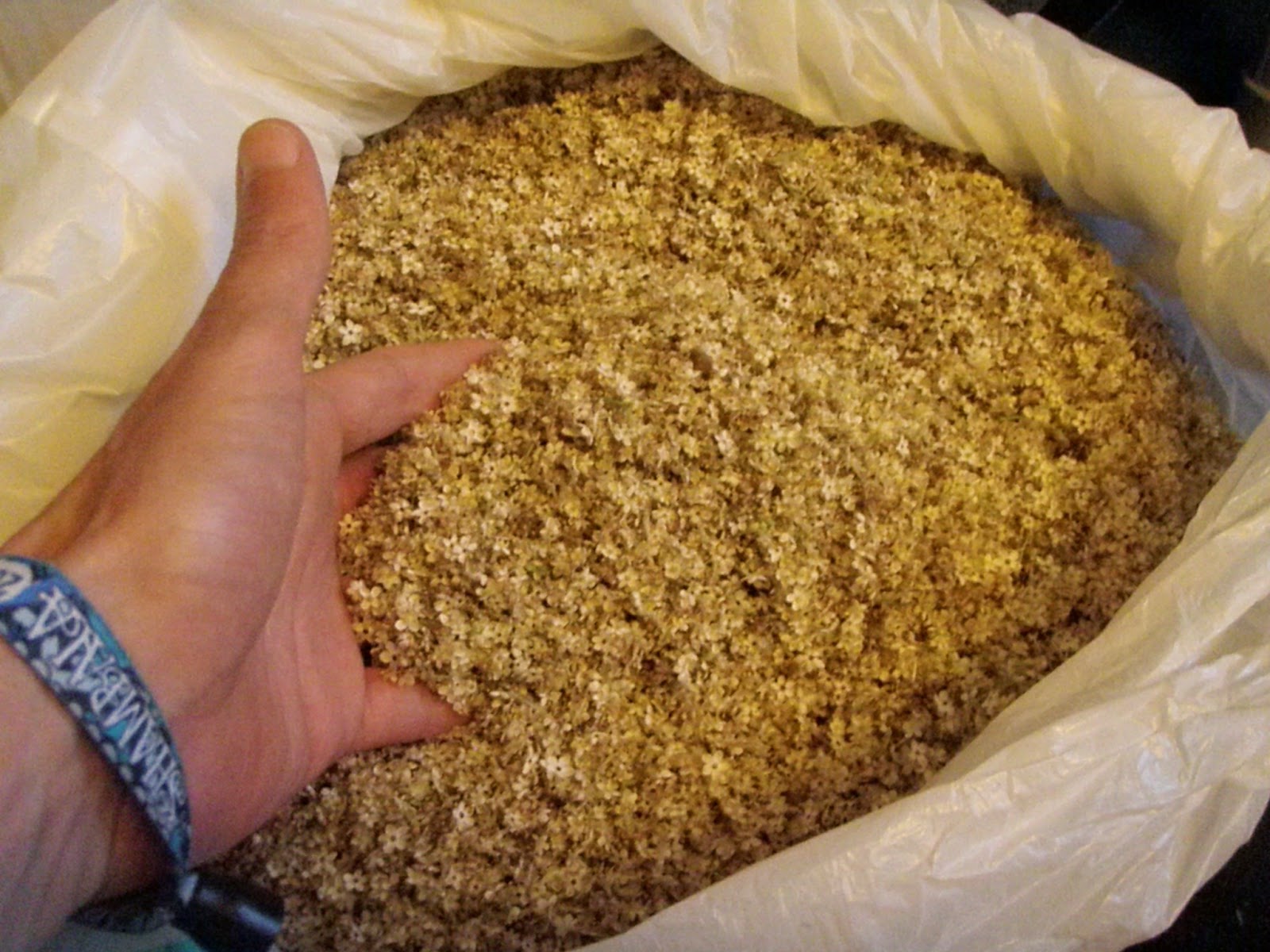
This year's haul of elderflowers

My plan was to use the quickie wine base, but only use grape juice (no apple juice). However there was a grape juice shortage in the UK. I thought it may have been a local issue, but a friend on the other side of the country had the same problem. The only supermarket stocking it in June was Asda. Not that i'm plugging Asda, my aim is to point you in their direction if the same problem occurs next year. So, as it turned out, i made 10 gallons with only grape juice, and 10 gallons with both apple juice and grape juice. Same as last year then.

Here's this years recipes.

Recipe 1. Elderflower wine. 5 gallons.

5 Litres White Grape Juice. Asda, pressed, long life
5 Litres Red Grape Juice. Asda, pressed, chilled
5 Teaspoon Citric Acid
4 Teaspoon Yeast Nutrient (Tronozymol)
2.9 Kg Sugar
GV5 Yeast
Elderflowers, 3 litres.

OG 1071


Method

Same old same old, you've seen it many times before.
Collect flowers on a dry sunny day. Drop them into a plastic bag and tie it. Leave overnight. Next day shake the bag for 5-10 minutes. Flowers and pollen will drop off the sprays. If your brew isn;t ready for them then put the flowers/pollen in the freezer.

Dissolve sugar in hot water. Pour into fermenting bucket. Add fruit juices. Dissolve citric acid in a little water and add to bucket. Add yeast nutrient and water to make the volume upto 5 gallons. Measure gravity and record it. Stir vigorously or use a whisk. The aim is to get air dissolved in the must cos the yeast needs it at the budding (reproducing) stage. Then add the yeast.

Stir daily, briefly. After about 5-10 days decant into a fermenting barrel under airlock. Add the elderflowers (in muslin bags). Leave it be for a week or so. Adding flowers late is good for 2 reasons.

  • The early days of fermentation are very vigorous and it blows-off lots of the delicate elderflower flavours ... straight out of the airlock.
  • The secondary fermentation stage is much gentler, and there is alcohol present. So you get better flavour extraction. And that means you need way less elderflowers, which means less time spent collecting and processing them.

After another week or so, when the fermentation has slowed right down, remove the flowers and rack to demi-johns. Then leave it be and in 4-6 weeks it'll be bright, crisp, light, clear and ready to drink. Something like 10-11%ABV. Don't be tempted to make it stronger by adding more sugar, it'll take longer to age and won't be any better quality.

Recipe 2. Elderflower wine. 5 gallons.


The ingredients and quantities are exactly the same as the above recipe. With one exception the method is the same too. The exception is that when i decanted the wine (in recipe 1) into the fermenting barrel is used it's lees to start recipe 2. The lees is essentially just a ready made healthy yeast colony that is raring to get going!

Be sure that you don't add hot liquids to the lees, else it'll probably kill the yeast. And save yourself something like £1.00 in the process! Hey count the pennies and the £££'s take care of themselves.

Recipe 3. Elderflower wine. 5 gallons.

As for recipe 2, i.e. on the lees, but a few little changes, nothing to be confused by tho.
Original Gravity (OG) 1065

Due to not being able to find enough grape juice i used a mixture (50:50) of white grape juice (5 litres) and apple juice (5 litres). The apple juices were 3 litres of Rio D'oro and 2 litres of Fruit Hit. There's nothing special about these brands (well the latter is organic and fairtrade), any apple juice will do as long as it has no artificial additives. Artificial sweeteners will not ferment so if you a juice containing these you'll end up with disgusting sweet wine. Preservatives will probably prevent your wine from fermenting. Whether the juice is pure pressed or from concentrate is only of concern if you're of the opinion that fluoridated water is bad for you. Cos diluted concentrated juices will probably use  tap water, i.e. fluoridated. But pure juice won't.

As a result of using apple juice you'll probably want to make another addition. Pectic enzyme (pectolase). Apples contain pectin, and this will make it most unlikely that you'll get a clear wine without some intervention. Pectin hazes are not easy to get rid of. Having said that there will be nothing wrong with the wine anyway, it's just that clear wine is easier on the eye. My pectolase was out of date, so i doubled the usual quantity i use. i used 10 teaspoons of it.

Also as a result of using apple juice i needed to add more sugar. This is because apple juice does not contain as much sugar as grape juice. i used 3.2 kg of sugar.

And finally i used 4 teaspoons of citric acid and 1 teaspoon of tartaric acid. i reckon the apple juice adds a little different flavour compared to grape juice alone. and as citric acid tastes like lemon juice i dropped some and added the clean tasting tartaric instead. It's the dominant acid in grape juice.

Recipe 4. Elderflower wine. 5 gallons.

As for recipe 3 but with 3.4 kg sugar added to raise the original gravity a little, to 1071.

BUT!!!! Something happened which resulted in an unintentional experiment. I forgot to take the elderflowers out of the secondary fermentation barrel when i went on holiday. It was some 5 weeks later that i removed them. and then another 2 weeks passed before i racked the wine. I feared that i had spoiled it with my forgetfulness. But I'm pleased to say that all worked out fine. This last batch has been ready to drink for 2 weeks and it's just fine. It was started on 30th June.

Thursday, 19 June 2014

Recipe: Blackberry Wine 2014

I had a busy autumn and winter so the blackberries picked last year stayed in the freezer for an age. Mrs Critterwines had her patience tested while i dilly-dallied. But finally in mid March 2014 i got busy. I know one friend (hey Craig!) still has blackberries in the freezer and is going to make this wine, so i'll give a pretty much full account of the recipe and method i used. Also why i did stuff as i did. If you're new to making a fruit wine on the pulp then you'll appreciate this. If you're not new to fruit pulp wine making then bear with me, after all you probably only need the recipe, and that's coming first.

Blackberries foraged in autumn 2013, with some ale sampling as a reward. Mrs critterwines almost features, but doesn't want to be a celebrity  ;-)

Recipe: 4 gallons.

7.550 Kg Blackberries (frozen)
4 Kg Sugar
5 Teaspoons Pectolase
3 Campden Tablets
1.5 Teaspoons Tartaric Acid
3 Teaspoons Citric Acid
Yeast Nutrient (Tronozymol)
Yeast (GV1)
Water to make liquid volume to 4 gallons

OG 1091 (i'm expecting a wine around 13% ABV)

Frozen blackberries, bagged

Note on Ingredients:

Blackberries - wash them to remove bugs, leaves, rotten fruit etc...  drain them a while, bag them and tie up the bags. stick in your freezer. if the bags are likely to get encrusted in ice then weigh them first cos doing so afterwards will be a technical complexity that you won't want to be bothered with when you're ready to brew. You need to take notes like this because when you make a stunning wine you'll want to repeat it.

Sugar - no need for any fancy brewing sugar. plain white sugar does the job. I use silver spoon cos it's local. if i didn't use that i'd use something fair-trade. Some folk say that beet sugar (silverspoon) isn't as good as cane sugar, that it has a very slight earthy taste. Personally i can't tell the difference and i've been brewing for over 20 years, and have tried both extensively. if you're a reductionist materialist (i'm not) then you'll probably argue that they are chemically identical, so there would be no difference. if you're not then you'll have plenty of reasons for insisting it could make a difference. Tho that doesn't mean we can pick it up reliably. The debate will run on and on for some time.

Campden Tablets - These help with 2 things. First of all they'll stun any wild yeasts on the berries. This means your chosen yeast will be able to breed (bud) and establish a healthy colony before the wild yeasts come to. You want your yeast to do the fermenting, not take your chances with a wild yeast. More on this later in the yeast section. The second thing it does is a little chemistry. I don't remember the details off the top of my head, and they're not important. The effect is that it helps with something called esterification. ester are powerfully fruit smelling/tasting molecules. The molecules that gives pear drops or pineapple chunks their flavours are esters. Campden tablets release sulphites, probably the most common food preservative out there. Some people are sensitive to it, most are not. Using campden tablets at this stage of a fermentation (i.e. at the start) probably results in nothing detectable remaining when the wine is ready to bottle. This is about the only stage i use campden tablets at these days. But if you;re new to brewing then i recommend you use it when you bottle too. Most novice brewers bottle too soon at some stage and get exploding bottles or bottles popping their corks. Using campden tablets will reduce the risk of this happening, greatly.

Pectolase - This is an enzyme, a biological catalyst. It breaks down pectin which can cause you problems with getting your wine to clear properly. Lots of fruit has pectin in it and if clear wine maters to you then use it. You can leave this out if you're funny about adding chemicals, but you'll often end up with hazy wine. Personally i am funny about chemicals, but i still use pectolase.

Tartaric & Citric Acids - Acidity is one of the qualities of wine that makes it wine. Grapes are very acidic, most other fruits are not as acidic, so we need to add more to get that wine like feel and quality. Brewers have a limited choice of acids to add to their non-grape wines. Citric (lemons), Malic (Apples) and Tartaric (grapes). Citric tastes like lemons, malic is harsh tasting and doesn't taste like apple, tartaric is pretty much clean tasting. This means tartaric acid won't interfere with the flavour of your wine, which can be important. But sometimes the lemon flavour of citric acid enhances the other flavours.

Personally i like lemon with blackberry, so i use more citric than any other acid. If you're into natural acids then the juice of one lemon is roughly equivalent to 1 teaspoon of citric acid.

Yeast Nutrient - yeast is a complex little critter and we don't know much about it at all. However we know that it needs more than sugar to be happy and healthy. One of the things it needs is nutrients. Grapes have plenty of yeast's favourite nutrients, but other fruits don't. So we have to give them a boost. Yeast nutrient contains some minerals but also vitamins. More expensive nutrients will smell a bit like marmite cos they have lots of B vitamins in them. The one i use is getting into the more expensive options. And don't worry, that strong B vitamin smell won't be in your wine. The yeast will gobble up all those vitamins.

Yeast - One of the most important choices you'll make when it comes to making wine. I chose to use GV1 (Gervin number 1) because i've used it before and i'm always happy with the results. The reason i chose it first time around was because it's low foaming (won't make a foamy head which invariably oozes out of fermenting bins and/or clogs up airlocks and is generally a pain to deal with). It's also a quick starter, which means that you'll soon see signs of fermentation. and thats good because the faster it gets going the less chance there is of your wine getting infected with a wild yeast. And it also ferments down to lower temperatures than many other yeasts. Great if you're fermenting in a cool room in the winter! Yeast strains usually come with a simple description of what they are good for. i.e red wines, white wines, low foaming, temperature range, acid metabolising or not, alcohol tolerance and so on. Picking one is quite easy. Just read the packet, you'll look like you know what you're doing even if you don't, and the descriptions really are very simple to follow.

A word on wild yeasts. Many novice brewers, especially those who are suspicious of food additives and so on, want to brew with a wild yeast, the yeast naturally present on the fruit. It sounds great and i'm sure there are plenty of commercial wine-makers doing this. However, those wine makers are in the business of ensuring that they get the desired yeast on their grapes. I don't know how they do it but i wouldn't be surprised if there were chemicals involved. Most importantly they know that any old random wild yeast is not the way to make good tasting wine. Candida is a natural yeast after all.

The reason it matters is that yeast doesn't only make alcohol and carbon dioxide. it's a little living critter of some sort (no-one knows precisely what it is!) and makes other waste products. some of which taste good, some don't. different strains make different products. Added to that is the fact that at different temperatures the same yeast will make different products. And different yeast strains have different alcohol tolerances. Ones that tolerate alcohol levels up to around 13% are not particularly common in nature. That's wine territory, so if your yeast will not tolerate alcohol above 5% then you won't get wine strength, you get beer strength. and chances are you added enough sugar to make wine. so you'll end up with a sweet fruit juice with some token alcohol content.

So combining the lack of control (through not knowing your yeast strain) over by-products, temperature requirements and alcohol tolerance means you're definitely shooting blind. If you don't mind this then go for it. Know tho that the chances of repeating a fortunate success are very slim. Natural yeast populations will vary year on year. I should add that if you go the wild yeast route you will almost certainly still like your wine. That's one of the joys of wine-making, even a failure is passable quality for the home-brewer, especially the novice or dabbler. But when you brew plenty, over many years, then you will wonder what you ever saw in those early brews when you didn't take advice. On the other hand if you want to make a wine that is fully natural and removed from artificial chemical or biochemical ingredients and processes then you have to go for it. You'll probably end up fermenting with honey, which i haven't done. Good luck with that journey, it's a whole other specialist world and if you want to try it then this blog won't help you.

Method:

Day 1 - Before bed remove your blackberries from the freezer and allow them to defrost overnight. pic below shows frozen berries in 5 gallon bucket, with my hand for scale.

Day 2 - unwrap the berries and tip them into a big container. mash them with a potato masher of your bare, washed, hands. do it til you're bored stiff. the more you do it the better. it may take 15 -30 minutes
for a few kgs. Don't be tempted to use a blender. you could split seeds and these have a strong bitter flavour which you won't want in your wine.

Once thoroughly mashed to pulp tip into your super clean fermenting bucket. Add crushed campden tablets, pectolase, sugar (dissolved in water). Stir well, cover and leave overnight. this is the stage when natural yeasts will be stunned by the sulphites (they be dozy from just coming out of the freezer anyway!). and the pectolase will start working on the pectin.

Day 3 - Add tartaric and citric acids, dissolved in water. Also yeast nutrient (quantity according to instructions on the packet). Then add water to what you think will make about 4 gallons of liquid. If your vessel has marking on it then i'd take it up to 4.5 gallons cos the berries take up room and will be removed eventually. Stir it very well, and even use a whisk to make sure that you get plenty of air dissolved in the liquid, like beating eggs. Yeast needs oxygen to reproduce (bud). And the sloshy stirring will also drive off sulphites, giving your yeast the best chance to make a flying start. Measure the gravity with a hydrometer and record it. Then add the yeast, cover and leave overnight.

From here on you may want to stir the must, sloshily, one a day for the next 3 or 4 days. Especially if the fermentation hasn't started. But aside from that keep it covered.

Day 8-10 - Decant or siphon your wine into a secondary fermentation vessel, fitted with an airlock. Leave as much pulp behind as you can. Do it gently cos there will be a lot of sediment in the primary fermentation vessel. thats the one that you started your wine in. You want to leave most of that sediment behind because there's lots of dead yeast in it. Make sure the airlock is fitted properly. Forget about your brew. It may ferment for a week longer, or maybe a few weeks.

Finishing off

When it's finished fermenting rack the wine into demijohns, with airlocks. Leave as much sediment in the secondary vessel as you possibly can. Your wine is now in the conditioning stage, and it does need that time. The flavour will be much better if you leave it for some months. You really don't have to do anything else, but you may want to do some other things.

1. You may want to degas the wine. This will help the wine to clear. dissolved carbon dioxide adds to the density of water, and this will make it a little harder for particles to drop and form a sediment. Suspended particles are what stops your wine from clearing of course. If you don't degas then your wine may have a slight fizz to it, called a frizz. Personally i like it in rose and white wine, but don't with reds. so i degas reds, and this is a red.

2. You may want to stabilise your wine chemically. i.e. add campden tablets (1 per gallon) and potassium sorbate (1 teaspoon per gallon). The former will stun any still living yeasts. The latter will stop yeast from budding. Both are common food additives but some folk don't like consuming them. These additions pretty much guarantee that there will be no further fermentation. Which is reassuring when it comes to bottling. These days i rarely use them.

3. If your wine doesn't clear after a few months then you have some options. First for me is degassing. If that doesn't work then i stabilise. If that doesn't work then i wait til winter and put the demi-johns outside on a cold night. sometimes the cold will make suspended particles drop to form a sediment. If it still doesn't work then i usually just put it away and forget about it for a couple of years. but you could try using finings. I've had success with chitin based finings (source: shellfish). You can also get gelatin based finings (source: pigs skin usually i think). Or you could try Irish moss (seaweed). Personally i wouldn't bother with trying anything else. Bentonite (clay) is good when used at the start of a fermentation, but at the end it can strip lots of flavour and colour too. You can also try filtering, but it's a bit fiddly unless you have an uber kitchen with lots of space.

Bottling

Once your wine is at least 6 months old, but preferably a year, then you can bottle it. Tho don;t bottle it unless you want to drink it or need the demi-johns for making more wine. Before you bottle it measure the gravity. it should be low. like 990 - 998. if it's higher than this then you have residual sugar and there's a chance your fermentation will start again in the bottle. if you stabilised this won;t happen. but if you didn't then its not worth risking bottling. exploding bottles are no joke. if you must bottle use corks, at least there's a chance to release the pressure if it does start fermenting. don't use screw caps, they won't blow. If you must use screw caps then use plastic bottles cos they won't explode, they'll expand massively before they pop. but storing wine in plastic for a long time is not a good idea.

And that's all folks, it was a long one. But it's good to go deep from time to time.

EDIT: Drinking it, 6 months later.

So time has passed and the wine is ready, properly ready. deliciously blackberry, will mellow around the edges a little with time. i.e. it's a bit sharp, but it's just balance cos it's not an all round big wine, so it won't do your stomach in! That's just my opinion tho, Mrs Critter Wines doesn't agree, and neither do other folk who've tried it.

Many brewers pretty much dismiss a straight blackberry wine, saying that elderberries improve it. Well it depends on your tastes to be honest. If you only like a big bodied red wine then go with elderberries. But if you also enjoy something a little subtler then give this a try sometime. I enjoy both, depends on my mood, food etc. And sometimes i just want a drink so anything will do!

Wednesday, 18 June 2014

Brief Update on December's Wines.

I've got a few "new" recipes to add, and i'll get around to that soon, but first a brief update on the wines i made in december 2013. Most of them were quickies, so me and mrs critterwines have been enjoying them for some months.

Cranberry & Blueberry: bit of an old faithful of a wine, and again turned out predictably delicious and easy drinking. No wonder i keep making it, and no wonder mrs CW keeps asking for it.

Passion Fruit: I hadn't tried this before, but wish i had. Its definitely our favourite quickie of the brews i'll be mentioning in this entry. Of all my brews only elderflower is more delicious. This is a quickie wine you must try. Stick to the recipe and method, don't be tempted to make it stronger by using more sugar. make sure that half your juice is grape juice (red or white, your choice).

Cherry: Hadn't tried this one before either. It's as good quality as the blueberry & cranberry tho doesn't have the crisp edge that probably comes from the cranberries. Still, i'll make it again i'm sure.

Sorrel: Another one i hadn't tried before and will repeat. It's very good. The wine is a little more grown up then either the cherry or the cranberry & blueberry. a little extra astringency is what i think does it. But it's pretty similar to both of them otherwise. I'm tempted to play with this a little more, make it a tonic kind of wine cos sorrel has health benefits. so i'm thinking ginger would probably go well with it for example.

Lemon Balm: I used the quickie base for this wine and the results are fine but not what i expected. The flavour of the lemon balm didn't really come out. My guess is that picking it in winter was bound to have this result. Regardless i have a very pleasant white table wine. When i bottled the second gallon i stuck a sprig of lemon balm in each bottle. It helped to infuse some flavour after a few days, and the bottles look beautiful. However the flavour was still delicate. When i bottle the last gallon i'll try 2 or 3 sprigs per bottle. ... and look out for ladybird grubs on the leaves, found one in an empty bottle! There's worse ways to go i guess.

Really you can't go wrong picking any of these brews. so pick which one floats your boat going on intuition and/or what you like the sound of and/or your own tastes, favourites etc. If you're really stuck, spoiled for choice perhaps, then go for the passion fruit. Or go with your budget, what juices are available and in your price range.

Thursday, 23 January 2014

It's 2014, what's in store this year?

Time flies, like a banana, so a funny someone said.

I'm looking forward to this year's brews. Partly because i failed in my mission to make 50 gallons last year, but i succeeded in making a number of new wines. Well, they were new for me anyway.

The two most recent recipes were done in December, it's just taken me a while to write them up. Life is getting busier and busier! I had planned on getting about 6 gallons of blackberry wine on the go too, but it just didn't happen. So sometime soon I'll be starting those brews. Nice way to start the year with a pulp wine or two. And we'll get half our freezer space back again, which will please Mrs Critter Wines no end!

We're also in parsnip season, and i just bottled the last gallon of the tanglefoot i made back in 2010. It is utterly delicious now, very grown up taste tho. Herby, grassy and a little earthy. arrggh that means a long wait for the next batch. I must keep my eye on the ball so i don't leave it so long next time.

Feel free to let me know how your brews go, if you followed the recipes strictly (recommended for quickie wines, tho you can use your choice of the 2nd juice, keep the grape juice tho). And likewise if you tweak the recipes for other wines, which i also recommend. It's good to experiment (and keep notes!), personalise your wines, our tastes will be different after-all.

Finally, clicking the donate button (on the right) will make me happy. But only if you can afford it and my blog has been useful. Think of it like this, if i chatted my blog to you in a pub would you buy me an appreciative pint? A virtual pint is almost as good.

All the best in the year ahead for making delicious country wine.

Recipe: Lemon Balm Wine, quickie

I've haven't tried making this wine before, but have masses of lemon balm in the garden. It's easy to grow and winter doesn't bother it, it just slows right down. I think it's a member of the mint family ... so be warned, it could take over if you decide to plant it in your garden! As well as being an ingredient in a country wine it also makes a good insect repellent, just rip off some leaves and rub on your exposed skin.

Winter probably isn't the best time to give it a go, the herbs smell much more potent in summer. But i reckon i'll get a subtle wine doing it now. I've stuck to two principles, the quickie wine method. It's such a good base that it's pretty much a no brainer to use it when it comes to trying something new that is effectively an infusion. Using lemon balm leaves need be little different to the method I use for elderflowers.

On that note the other principle is late addition, i.e. adding the leaves late. It's not only economical as you need less leaves (the flavour extraction is improved) but also less of the flavour is blown out of the must during vigorous primary fermentation. So you maintain a full range of flavours, the more volatile molecules staying dissolved.

So the recipe!

Recipe: 3 Gallons

3 Litres White Grape Juice (Rio D'Oro)
3 Litres Apple Juice (Fruit Hit, fairtrade)
2 Kg Sugar
3 Teaspoons Citric Acid
3 Teaspoons Pectolase
1 Teaspoon Yeast Nutrient (Tronozymol)
Yeast (GV11, Lees from Sorrel wine)
70g Lemon Balm Leaves

OG 1074

Piccie time, it takes a lot of leaves to tip the scales. This was about all the vibrant leaves from our lemon balm patch in december. The rest looked a bit tried and didn't have much smell. So the haul was smaller than i would have liked, we'll see how it works out in a few more weeks.


Method:

It's the same as any generic quickie wine. Keep the gravity low (1070-1080 is fine), lower probably better. We're aiming to keep the alcohol content, acidity, body etc in balance. Which means rapid conditioning so you can drink your table wine quality homebrew in 8 weeks from start-up. If you up the alcohol content then you need to up everything else, and then you need to wait months or years before it's worth drinking.

So dissolve your sugar in a pan of water on the stove. While that's happening pour the fruit juices into your fermenting bin, add the acid, pectolase and yeast nutrient. Allow the sugar solution to cool then add to the fermenting bin. If you don't let it cool then you will probably kill the yeast in the fermenting bin. That's assuming you're doing a fermentation on the lees of the previous brew. If you're not then make sure the must is cool enough before adding the yeast. Make up to 3 gallons with cold water.

Give it all a good sloshy stir, record the specific gravity, cover. You probably won't need to stir it daily because the yeast in the lees will be a big healthy colony. So after a few days (5-7 ish) transfer your must to a secondary fermenter fitted with an airlock.

Then add the lemon balm leaves in a muslin bag. I put the bagged leaves into a pan containing a little  water and brought it to the boil. Then added a little sugar to make a solution roughly equal in gravity to the original must. Then added the bagged leaves and sugar solution. It was probably only a litre of liquid with about 230g of added sugar.

Now follow the normal procedure, remove leaves and rack to demi-johns after a week or so, ideally. I got forgetful and took them out 2 weeks after adding them! I think i got away with it cos all smelled fine in the secondary fermenter and there was no visual signs of anything being wrong. Stabilise etc when the time is right.

Verdict:

It's now December 2015, 2 years since making this wine and we've just popped the cork on the last full bottle. WOW!

I think i've said many times that a quickie wine won't improve with any aging over 1 year, but this one has. Perhaps it's the post-fermentation infusion that makes it the exception to the rule. So let me tell you about it.

First impression is a little complex, but if you drink it in company then discussion will soon simplify it. What me and the Mrs quickly agreed on was a grown-up wine. It has fruitiness (i think tinned peaches and/or lychees, the former is something you'll smell). It's also medium sweet, very unexpected, with a herby base, and has a lovely roundedness, a slight syrup feel.

So, i gotta make more next year (2016) and then wait 2 years for it. I think the quality of the apple juice may be a crucial factor, also the yeast. So repeating those ingredients is a must. That could be tricky if the juice is a blend of apples ... but perhaps the good folks at "fruit hit" employ a jedi master blender.

Make this wine if you like your whites grown up and complex. And by the way growing lemon balm is a breeze seeing as it's mint family. 2 years on and it's well established in one part of our garden, needs no caring for but lots of cutting back cos it's so vigourous.

Recipe: Sorrel Wine, quickie

I've never tried making this wine before, but have long fancied giving it a try. As a result you'll have to wait a while for me to report back on how it turns out. I've stuck to two principles tho, first the quickie wine method. It's such a good base that it's pretty much a no brainer to use it when it comes to trying something new that is effectively an infusion. Using sorrel flowers need be little different to the method I use for elderflowers.

On that note the other principle is late addition, i.e. adding the flowers late. It's not only economical as you need less flowers (the flavour extraction is improved) but also less flavour is blown out of the must during the vigorous primary fermentation stage. So you maintain a greater range of flavours, the more volatile molecules staying dissolved.

Onwards then, the recipe!

Recipe: 3 Gallons

3 Litres White Grape Juice (Rio D'Oro)
3 Litres Apple Juice (Rio D'Oro)
2.1 Kg Sugar
3 Teaspoons Citric Acid
3 Teaspoons Pectolase
1 Teaspoon Yeast Nutrient (Tronozymol)
Yeast (GV11, Lees from Green Tea and Ginger)
50g Sorrel Flowers

OG 1075

Method:

It's the same as any generic quickie wine. Keep the gravity low (1070-1080 is fine), lower probably better. We're aiming to keep the alcohol content, acidity, body etc in balance. Which means rapid conditioning so you can drink your table wine quality homebrew in 8 weeks from start-up. If you up the alcohol content then you need to up everything else, and then you need to wait months or years before it's worth drinking.

So dissolve your sugar in a pan of water on the stove. While that's happening pour the fruit juices into your fermenting bin, add the acid, pectolase and yeast nutrient. Allow the sugar solution to cool then add to the fermenting bin. If you don't let it cool then you will probably kill the yeast in the fermenting bin. That's assuming you're doing a fermentation on the lees of the previous brew. If you're not then make sure the must is cool enough before adding the yeast. Make up to 3 gallons with cold water.

Give it all a good sloshy stir, record the specific gravity, cover. You probably won't need to stir it daily because the yeast in the lees will be a big healthy colony. So after a few days (5-7 ish) transfer your must to a secondary fermenter fitted with an airlock. Then add the sorrel flowers in a muslin bag. I put the bagged flowers into a pan containing a little  water and brought it to the boil. Then added a little sugar to make a solution roughly equal in gravity to the original must. Then added the bagged flowers and sugar solution to the must. It was roughly a litre of water with 230g of added sugar.

Now follow the normal procedure, remove flowers and rack to demi-johns after a week or so. Stabilise etc when the time is right.

Monday, 23 December 2013

Recipe: Green Tea & Ginger Wine

Well I resolved to brew a lot this month, and so far i'm keeping up. I started this wine last night and pitched the yeast tonight. It's an old favourite, but with a twist. As much as the previous versions we're all delicious i reckon it can still be improved. I know it doesn't have to be perfect to be excellent, so i'm doing anything radically different, just tweaks. You can see previous versions on my index page here my brew list (and there's also a link on the right if you're new here and need a pointer).

Recipe, 5 Gallons

5 Litres White Grape Juice (Rio D'Oro)
5 Litres Apple Juice (Rio D'Oro)
3.45 kg Sugar
200g Green Tea (Sencha)
200g Root Ginger
Zest of 3 Lemons and 2 Limes
5 Teaspoons Citric Acid
5 Teaspoons Pectic Enzyme (pectolase)
4 Teaspoons Yeast Nutrient (tronozymol)
Yeast (Gervin 11, GV11, formerly known as GV D)

OG 1064 (see method section below)

Couple of ingredients piccies,
first the green tea (yup splashed out on the posh stuff!)


... and second the zest, lemons and limes, the knife evidence of removing the pith that the potato peeler left behind. painstaking work, but worth it.


Method:

Put a pan of water on the stove, a gallon sized pan or bigger. Add the sugar and dissolve it on the heat. While that's on the go put 100g of green tea in each of two muslin bags and tie them up. Use 2 bags rather than one to give the leaves plenty of room. Tip the hot sugar solution into your primary fermenting bin, then cover it. Now refill the pan, put it back on the hot stove, get it good and hot and then chuck in the muslin bags of green tea. Bring to the boil then turn off heat.

While the tea is coming to the boil add the 10 litres of fruit juices.  Now add the tea, but keep the muslin tea-bags in the pan. Re-cover the brew to be. Refill the pan with water and make another brew on the stove. Rinse out the cartons and add rinsings to the fermenting bin. Then add the second batch of tea, including the tea-bags.

This will all be very warm, even hot. So don't even think about adding the yeast. Cover it up. Next day add the pectolase, citric acid (or lemon juice) and yeast nutrient. Stir sloshily to get plenty of air into the must, yeast needs oxygen to multiply (bud) and that's the most important thing for it to do initially. It'll form a good sized colony quickly and help to ensure it's the dominant yeast. Measure the gravity and adjust with sugar solution or water to make it up to 5 gallons and your desired strength. And then and the yeast.

My gravity was 1064 but not quite 5 gallons. I decided to go ahead with pitching the yeast anyway. When i transfer to secondary fermentation i'll make the volume up to 5 gallons with a number of sugar solution additions. I'll be aiming to up the gravity by about 20 points (equivalent to an OG of about 1084) which will produce a wine of 12-12.5% ABV.

After a few days finely chop or grate the root ginger, and zest the citrus. Add both zest and ginger to another muslin bag and drop them into your secondary fermentation vessel. transfer the happily fizzing must to secondary fermentation under airlock. And proceed as usual from here. i.e. racking, degassing, stabilising at the appropriate times.

Discussion:

I've decided that i want a pretty robust and full flavoured wine with texture. But i don't want a sweet strong wine. The late addition of ginger should ensure a proper unmistakable ginger kick. And the zest should give a slight oily liquer-like texture as well as flavour. I'm using lemon and lime because i think they'll enhance the ginger, and the mix will hopefully add to the flavour mix. I do want this complex, but not confusing, and clean but complex is something i'm very interested in achieving. You could try other zests, if i were to try another it would be grapefruit. I think orange would be confusing, but that's just personal. Ginger and orange do go well together as flavours. I splashed out on some expensive green tea because i want to capture a little more flavour.

Tannin or oak chips? hmmm, good question. This will be a wine that can take either, but probably not both unless you halve the usual quantity of each. I think i'd steer clear of doing both tho, it'll be complex enough. Both will add astringency, the straight tannin more so. I think i'll add some oak chips, cos i have an open packet. It's not a 5 gallon dose, but that suits me, adding a subtle little extra will be just about right. I don't anticipate drinking this for 2 years.

The yeast is chosen because it's acid reducing. This refers to malic acid that will be in the apple juice. It's a harsh tasting acid and while the ginger may mask it i don't want to chance it. Gervin 11 (GV11 for short) is the yeast of choice. It used to be known as Gervin D (GV D), but has undergone a name change. Muntons (the supplier in the UK) assures me that it's the same yeast, even tho it doesn't say "acid reducing" on the sachet. It's also a thoroughly reliable yeast, quick starter, and low foaming.

Juices ... you could use grape juice alone, but make sure to use 10 litres. The juice content needs to be 10 litres in 5 gallons. If you do then your wine will be very similar. It may even clear a little faster. It'll probably be a little cleaner tasting, the apple juice adds some other flavour to the finished wine. The results are barely distinguishable, but i slightly favour the flavour of the one with both apple and grape juice. It's very marginal tho and if this is your first stab at the wine you'll probably not notice anyway. This wine is different, but delicious, and that will be your lingering first impression. Especially if you drink it with spicy food. This is a must try, especially anything with both chilli and ginger in it. It is the perfect drink for this sort of food. Try it and see, i reckon it's better than beer with a curry. But if you can get your hands on some Blandford Fly (a real ale) then you have to try that too!

Saturday, 14 December 2013

Recipe: Cherry Quickie

... and so my late dash to up my volume of brews for the year continues. This is one i haven't tried before, Cherry Quickie. I have made a cherry wine kit (Youngs) and found it pleasant easy drinking. And i've made wines with cherries as part of a mix of various fruits, and that was delicious. So it's time to try a cherry quickie.

Recipe, 3 Gallons:

3 Litres Red Grape Juice (Rio D'Oro)
3 Litres Cherry Juice Drink (Cherry Good)
2 Kg Sugar
3 Teaspoons Citric Acid
2 Teaspoons Pectolase
2 Teaspoons yeast Nutrient (Tronozymol)
Yeast (GV1, lees from previous brew, passion fruit quickie)

OG

Method:

Just like every other quickie wine. Have a rummage about on my index page (click > "my brew list") and find a quickie wine from the list for details).

Discussion:

I chose citric acid cos i'm low on tartaric acid. Citric acid should work well tho, it's a safe bet. It may add a bit of lemon flavour but that's not a bad thing.

This Cherry Good juice also has some elderberry concentrate in it. i had a mouthful to see how strong that flavour was, and barely noticed it. My experience of elderberries (as a small proportion of fruits) in red wine brews is positive. So i think this will only improve the wine.

Monday, 9 December 2013

Cheeky ...

This little button, here on the right, "donate" >>>>>>

it's way cool. you get to click it, do the paypal or credit/debit card thing, and buy me a virtual drink to say "thanks for the great blog, you saved me a fortune and i get to drink delicious wine too!" So click away. It's simple and it works, it's been tested.

If you can't afford to buy me a drink then i comprehend that, being somewhat used to that situation myself. Don't worry, you'll always be welcome here. If you can afford to then i'd really appreciate it just now. And you're "doing very well thank you" then you can donate as much as like. Isn't that brilliant! just when i need a salary you could give me one!

And now, back to talking brewing. I've been updating, so there's plenty to read.

Something to be Aware of

Yeast talk: GV D is now GV11

A few months ago i tried to buy Gervin D yeast (GV D). This is the acid reducing yeast that i'm very fond of. The label has changed, but i'm assured the yeast has not. It's now known as Gervin 11 (GV11). However it no longer says that it's malic acid reducing on the label. I guess that means we can all look like we have the uber smarts if we have this little nugget of unpublicised information. How exciting! OK, that's very homebrew geekery! Muntons assure me (by email) that all their other Gervin yeasts have the same labels as before. I'll try to update my "index" page, but i may miss one or two.

Recipe: Passion Fruit Quickie

First of all humble apologies. I've had a very busy year, so not only have i neglected my blogging duties but i've also slacked with the brewing! True, i had a very promising June with 20 gallons of Elderflower quickie versions (and i've written the last two up now ... here and here, and written a comparison of the 4 different brews). Since then i've brewed nothing until a week ago. And i realised that if i wanted to do my usual 50 gallons a year then i need to step on it and set up a production line. So i made a plan. The previous brew (blueberry and cranberry) was the start of the plan, this is step 2.

Trying Something New

Recipe (3 Gallons):

3 Litres Passion Fruit Juice Drink (Sainsbury's)
2 Litres White Grape Juice
1 Litre Red Grape Juice
2 Kg Sugar
3 Teaspoons Citric Acid
2 Teaspoons Pectolase
Nutrient (2 teaspoons Tronozymol)
Yeast (GV1 Lees from previous brew)

OG 1075

Method:

It's another quickie, so check out the last brew for the summary method or find an old "quickie" wine recipe and method here in my "index" for details.

Discussion:

Not much to say really, this wine is always a winner. I used a mix of red and white grape juices for no good reason. You can use either or a combo yourself. The only difference will be the colour of the wine.

NB: when buying a "juice drink" check the ingredients. Often they have added artificial flavours, colours, sweeteners or preservatives. You may not care, but then again you may. These juices from Sainsbury's were all natural. The two biggies to watch out for are ...

  • Preservatives because they may well make it hell to get your wine started. The preservatives could mess with the yeast you add.
  • Artificial sweeteners. To my mind these are one to avoid always. There's plenty of people talking about how dangerous they are, linking them to all sorts of things including cancer. However from a purely brewing perspective avoid them. They won't ferment, they'll be utterly unchanged, so your wine will end up being way sweeter than you're used to.
 

Counters
Lamps Plus Lighting